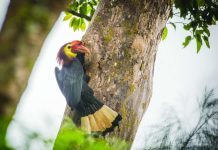



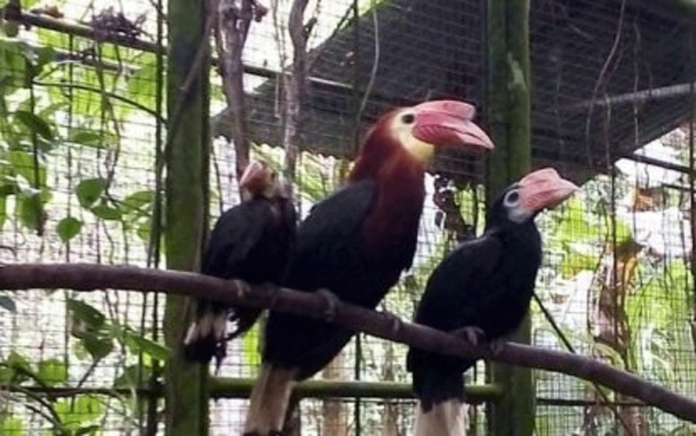
ILOILO – A newly-bred writhed-billed hornbill, considered as the world’s second most critically-endangered hornbill, has given hope to its kind.
It finally flew last week while in captivity inside the Mari-it Wildlife and Conservation Park in Barangay Jayubo, Lambunao, Iloilo.
The male chick hornbill got out from the nest on Dec. 28, 2020 and was able to flap its wings and fly on Jan. 10, said Dr. JB Ian Bullo, veterinarian at the West Visayas State University – College of Agriculture and Forestry (WVSU-CAF) and assigned at the park.
“It took around one and a half-month before we heard chirps from the newborn chick,” he said.
The park has 15 birds of this species also known as “dulungan” or the Visayan wrinkled hornbill. But only one pair was able to breed and only one egg was laid and hatched.
This bird is monogamous and its mate serves as its partner for life.
The breeding period of hornbills usually starts in September. It is the male that prepares the nest.
“Losing their partner will greatly affect breeding. They will not breed with other birds they are not compatible with. When the female starts to lay eggs, it will seal itself in a hollow tree trunk and rely on the male partner to feed her and the future chick. If the male is killed while the female is still sealed together with its chick, they may suffer and die from hunger,” said Bullo.
The park is currently observing the new chick if it is independent enough to collect its own food. While it can already fly, it still relies on its parents for food.
Bullo said it usually takes a month after leaving the nest that the chick can already be separated from its parents.
They plan to name the hornbill “Bebong” after the current president of the university.
The veterinarian said the support extended by the university, local government unit of Lambunao, the Department of Environment and Natural Resources (DENR), and the Talarak Foundation Inc., helped in the successful breeding of the bird.
The last successful breeding inside the center was in 2011, a female hornbill.
Mari-it (enchanted) is the first conservation, breeding and rescue park in Panay Island. It is situated in a 1,000-hectare lot within the 3,000-hectare campus of the WVSU-CAF in Barangay Jayubo, some 16 kilometers away from the town center of Lambunao.
Aside from the Visayan writhed hornbill and endangered Visayan tarictic hornbill, the park also hosts the endangered Visayan spotted deer; the critically endangered Visayan warty pig; th e vulnerable Visayan leopard cat and the cloud rat, among others.
As breeding the endangered writhed-billed hornbill is delicate, Bullo said they need all the help they could get to ensure its success.
“We need to give the birds optimum rations and facilities not only during the breeding season but whole year-round in order for the birds to stay in the right condition to breed again. Operating expenses remain the biggest hurdle of the center and help of any kind is very much welcome,” he said.
Meantime, Lambunao tourism officer Jennifer Osorio said the quarantine period helped a lot because their environment was not disturbed.
“Our endangered species are stressed every time there are visitors,” she said.
Since the season for breeding is over and the restrictions have relaxed a bit, Osorio said that the park is already open and visitors can view the baby hornbill.
However, health protocols such as wearing of facemasks, logging in and out, and stepping on a footbath for disinfection must be observed. (PNA/PN)