



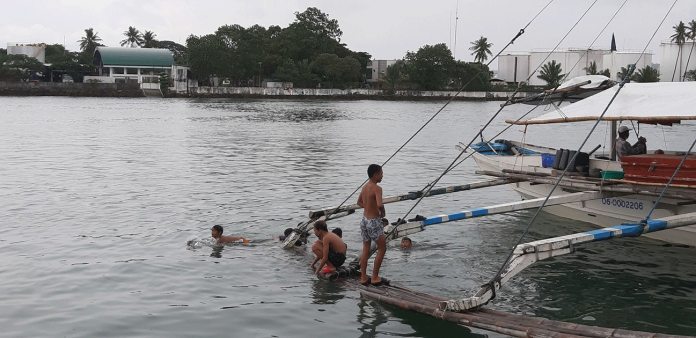
ILOILO City – Is it safe now to swim or take a bath in the Iloilo River?
The City Environment and Natural Resources Office (CENRO) said swimming is not recommended. The pollution load of the river is still high, according to CENRO head Engineer Noel Hechanova.
The bio-chemical oxygen demand (BOD) of the river is more than 200mg/liter, way higher than the normal level which is 50mg/liter, said Hechanova, citing the result of a recent water quality testing.
“Indi gyapon ko ‘ya mag-recommend nga maligo dira,” Hechanova told Panay News, as the world marks Environment Day tomorrow, June 5.
On the other hand, Ronald Limua, head of the Environmental Monitoring and Enforcement Division of the Environmental Management Bureau (EMB) Region 6, said their 2020 monitoring showed the Iloilo River’s fecal coliform bacteria level ranging from 10,042 to 458,912 MPN (most probable number) / 100 milliliter (mL), way above the standard 200 MPN per 100 (mL).
Fecal coliform bacteria are a group of bacteria that are passed through the fecal excrement of humans, livestock and wildlife. They are an indicator of water quality.
In general, increased levels of fecal coliforms provide a warning of failure in water treatment or possible contamination with pathogens. When levels are high there may be an elevated risk of waterborne gastroenteritis.
“Pwede sia (Iloilo River) paligoan kun magnubo sia (coliform bacteria) sa 100 MPN/100ml,” said Limua.
REGULAR SIPHONING
Hechanova said the solution is the regular siphoning of septic tanks. Septic tanks’ wastes are major contributors to the river’s pollution.
“Need ta gid manglimpyo sang river to maintain ang aesthetics niya pero indi na daku nga bagay nga ga-contribute gid. Septic tanks gid ang big contributor,” said Hechanova.
Not only those living in the squatters’ area but everyone’s septic tanks, including those of business establishments, contribute to the pollution, except big malls and hospitals which have sewage treatment plants.
“Everyone have to clean their septic tanks. We must remember nga ang septic tank is only partial treatment. All septic tanks end up in the river or coastal areas. A septic tank should be connected to a sewage or treatment plant,” Hechanova stressed.
The ideal is to siphon septic tanks every five years, he said.
The CENRO head noted that Iloilo City has an ordinance passed in August 2017 establishing the Septage Management Program in the city.
The ordinance requires households, businesses and institutions to have standard septic tanks. They are also required to clean these waste facilities every three to five years.
The septage management system is mandated by Republic Act 9275, or the Clean Water Act of 2004.
However, there is difficulty enforcing it. Not many can afford to pay more or less P5,000 for the cleanup of their septic tanks, said Hechanova.
Under the ordinance, waste materials from septic tanks must be removed and transferred by a duly-accredited hauler/pumper to a treatment facility following the Department of Health’s (DOH) guidelines and other government regulations on dislodging and transport of sludge, except those that are operating under the supervision of the Metro Iloilo Water District.
No septage hauler/pumper shall unload or dispose untreated septage in any other place except through accredited septage treatment facilities including, but not limited to bodies of water, agricultural fields and the drainage system within the city, the ordinance stated.
Hechanova has a proposal — subsidize the cleanup of septic tanks. The city government will collect the additional fee via the real property tax (RPT).
He likened this to the system in Manila; water concessionaires pay additional fees monthly for the siphoning of septic tanks through the water bill.
“Isa ka proposal kada bayad sang RPT masukot kita abi para sa pasuyop, sa tan-aw ko madamo sang kautoran ta ang ma-subsidize… Pwede ta malikop ang tanan bisan mahal ang serbisyo pero malikop ta eventually by three to five years bilog nga mga kautoran ta nga indi ma-cover sang water district,” explained Hechanova.
He also noted that the water district here is planning to establish a sewage treatment plant.
The CENRO is also finalizing the creation of a city septic management authority, a body that will have the control in the operation of treatment plants in the city. It will be composed of representatives from different government agencies like Department of Environment and Natural Resources and DOH.
“Amo ina ang ginatinguha namon subong. Kon matapos ina, kundi maamat-amat naton alibyo ang Iloilo River,” he added.
ABUNDANT CATCH
On the other hand, Hechanova noted that with the lower BOD level, the dissolved oxygen has also improved; this explains the abundance of fish species in the Iloilo River.
The Iloilo River is an estuary river. It starts in Oton, Iloilo at Batiano River, which is also an estuary, then traverses through the Iloilo City districts of Lapuz, La Paz, Mandurriao, Molo, Arevalo and the City Proper, before emptying into the Iloilo Strait.
As an estuary, the river level fluctuates with the tides. This flow brings in nutrients from the sea, which makes the Iloilo River a nursery for fish species.
The banks of the river are home to 22 of the country’s 35 mangrove species,
City hall recently tapped private partners and public organizations for massive mangrove reforestation along the Iloilo Esplanade at the riverbanks.
Mangroves are considered as fish sanctuary and home to other marine life./PN