



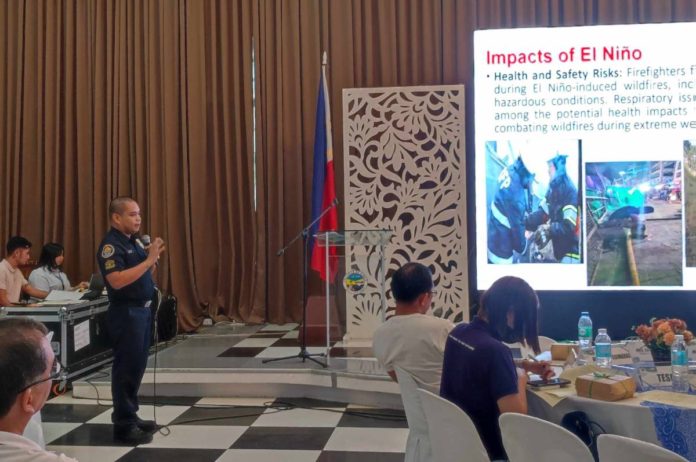
ILOILO – As the effects of the El Niño phenomenon kick in, coupled with the approaching summer season, Western Visayas is witnessing an increase in fire incidents.
The situation is further compounded by two significant challenges faced by the Bureau of Fire Protection (BFP) in its firefighting efforts.
Senior Fire Officer 3 Romelo Aguilar, the acting municipal fire marshal at the Zarraga Fire Station, reported that fires in Iloilo province have doubled in the first quarter of this year compared to the same period last year.
“There has been a surge in grass fires, which have almost increased by up to 200 percent compared to last year,” Aguilar mentioned during his presentation to Fire Superintendent Bartolome Beliran, the provincial fire marshal of BFP-Iloilo.
During a special meeting of the Provincial Disaster Risk Reduction and Management Council on Tuesday afternoon, March 12, Aguilar outlined the agency’s action plan.
He highlighted two major challenges in firefighting – concerns over water sources and the condition of fire trucks.
“The primary constraint or challenge is securing water sources during fire incidents and the availability of operational fire trucks,” Aguilar said.
He explained that the prolonged dry and hot weather patterns are causing a gradual decline in water levels in sources such as rivers and deep wells, occasionally impacting their firefighting operations due to inadequate water supply.
Moreover, many of the fire trucks are old and in poor condition, presenting risks even to the responders.
“These challenges and constraints are also noted by our local chief executives, particularly in the 1st and 2nd districts of Iloilo, which have somewhat older fire trucks,” Aguilar said.
He specifically mentioned the two districts because of the high incidence of forest fires in towns such as Igbaras, Tubungan, San Joaquin, and Guimbal.
However, Aguilar noted that the BFP, along with local government units (LGUs) and the Iloilo provincial government, are exploring options to replace the old fire trucks.
El Niño and Fire Incidents
In his presentation, Aguilar explained how El Niño could cause a spike in fire incidents.
During El Niño events, dry and hot conditions can elevate the risk of wildfires, especially in forests and grassland areas. This puts additional pressure on the BFP to respond to a higher frequency of fire incidents, including bush and forest fires.
Aguilar admitted that the BFP faces challenges in fire suppression, such as in cases of wildfires being fueled by dry vegetation and strong winds.
The BFP may encounter difficulties in accessing remote or rugged terrain where wildfires occur, as well as in containing rapidly spreading fires that threaten communities and infrastructure.
Firefighters also face heightened health and safety risks during El Niño-induced wildfires, including exposure to smoke, heat, and hazardous conditions. Respiratory issues, heat exhaustion, and injuries are among the potential health impacts that firefighters may experience while combating wildfires during extreme weather events.
Because of this, the BFP is pushing for collaboration in responding to wildfires during El Niño because this requires close coordination between the BFP and other relevant agencies, including the Department of Environment and Natural Resources (DNER), LGUs, and disaster management agencies.
“Joint efforts are needed to mobilize resources, conduct fire risk assessments, and implement preventive measures to mitigate the impacts of wildfires,” part of Aguilar’s presentation.
How to Reduce the Number of Fire Incidents?
Among the measures presented to aid in mitigating fires are the following:
* Intensified the conduct of fire safety inspections on all buildings with all types of occupancy.
* Intensify fire safety enforcement in the BFP and institutionalize standard processes in the conduct of inspections, defining the accountabilities of concerned BFP personnel in the issuance of Fire Safety Evaluation Clearance, Fire Safety Insurance Clearance, and Fire Safety Clearance and Standard Operating Procedures in the preparation of inspection orders and after inspection reports.
* Mitigate fire hazards through fire safety activities such as Fire Code Revenue Awareness Month and Fire Prevention Month.
* Conduct of fire truck visibility within the area of responsibility
* Identification of alternative sources of water for firefighting units that can be utilized in the event of conflagration as a consequence of El Niño
* Intensification of the following fire prevention programs and activities, such as the conduct of OPLAN Ligtas na Pamayanan; fire prevention seminars for all barangays; and the conduct of simulation exercises and drills, among others.
* Conduct a comprehensive fire risk assessment to identify areas prone to wildfires during El Niño periods.
* Implement fire prevention measures such as clearing vegetation around homes and infrastructure, establishing firebreaks, and enforcing regulations on land use and fire management.
* Strengthen fire monitoring and early warning systems to detect and respond to fire outbreaks promptly.
* Pre-position of fire engines from NGOs and the Volunteer Fire Brigade in cities and municipalities with unserviceable and dilapidated fire trucks to be funded and mobilized by the provincial government
* Conduct strict measures to minimize the usage of fire trucks in LGUs other than fire suppression and fire prevention activities such as flushing and water rationing.
OCD-6 Prepares for Possible Water Scarcity in Firefighting
For its part, the Office of the Civil Defense (OCD) Region 6, headed by Director Raul Fernandez, admitted worrying about the supply of water for firefighting if fire incidents and the dry season persist.
“Narinig ko rin sa balita na according sa city fire, they have enough water pa naman pero kung tuloy-tuloy ang sunog baka kulangin ‘yong tubig natin kasi parang araw-araw may sunog, so kung parating mangyayari ‘yan made-deplete ‘yong ating tubig,” Fernandez told Panay News.
In line with this, an emergency meeting was called by the Regional Task Force El Niño headed by Fernandez on Tuesday afternoon to conduct a risk assessment on different sectors, particularly agriculture, water, and health, due to the El Niño phenomenon.
Fernandez wants to know the level of water sources in the region so that the water security sector can carry out mitigation measures.
The water security sector is composed of the DENR, the National Irrigation Administration, the Mines and Geosciences Bureau, and water districts and bulk water suppliers.
“Kailangan natin ma-appraise kung ano talaga ‘yong water situation natin ngayon at kung hanggang kailan maka-sustain tubig as for now,” Fernandez added./PN