



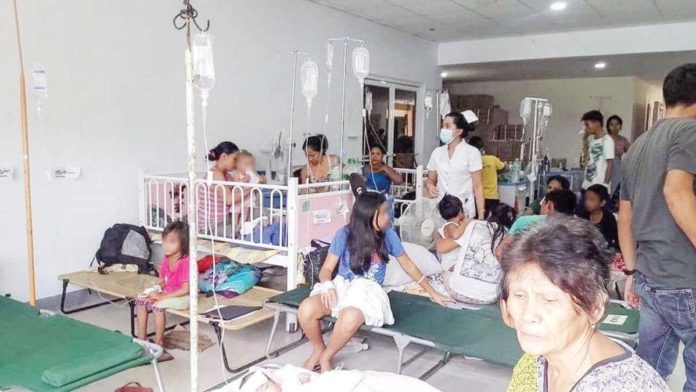
ILOILO – In response to the escalating dengue cases, the Iloilo Provincial Health Office (IPHO) is urging the public to first visit Rural Health Units (RHUs) in suspected cases of dengue before heading to hospitals.
This aims to prevent the overwhelming of hospitals with dengue patients and to ensure they can continue to serve others with different medical needs.
Currently, the 13 district hospitals, including the Iloilo Provincial Hospital, are treating approximately 100 dengue patients.
Despite managing only these cases, the hospitals are experiencing an occupancy rate exceeding 100 percent, attributed to the influx of various other patients.
These hospitals have a total bed capacity of 959.
Dr. Rodney Labis, chief of IPHO’s Health Service Delivery Division, explained, “Our system at RHUs is being strengthened as not all dengue cases require hospital admission. According to national and international data, about 80 percent of dengue cases are manageable at the outpatient level in RHUs.”
Labis noted that while RHUs are equipped to diagnose and manage dengue, many community members directly go to hospitals when they suspect dengue, driven by fear.
“Part of our strategy is to enhance community awareness. If there are symptoms of dengue, the first point of contact should be RHUs, where it can be determined if the case is manageable there. Hospitals should be decongested to accommodate more severe cases,” added Labis.
The IPHO has ensured that RHUs are well-equipped with intravenous (IV) fluids, dengue test kits, medicines, and other necessary supplies to handle dengue, particularly mild cases.
Dengue fever, a mosquito-borne tropical disease, typically manifests with a high fever, headache, vomiting, muscle and joint pains, and a characteristic skin rash. In severe instances, it can escalate to dengue hemorrhagic fever, potentially causing bleeding, blood plasma leakage, and death.
In light of potential surges, the IPHO has prepared contingency plans, including coordinating with the Iloilo Sports Management and Development Office to potentially use the Iloilo Sports Complex as a temporary facility for dengue patients.
This complex, previously a quarantine facility during the COVID-19 pandemic, can accommodate up to 10 beds, with provisions to expand if necessary.
Recent statistics from June 29 to July 6 indicate a significant rise in dengue cases, totaling 245 in the province.
From January 1 to July 6 of this year, Iloilo recorded 1,708 dengue cases, marking a 106 percent increase compared to the same period in 2023, which saw 829 cases.
Lambunao (121 cases with one death), Passi City (97), and Badiangan (87 cases with two deaths) are among the municipalities with the highest incidences.
The others are Calinog (81), Oton (74), Miag-ao (59 cases with two deaths), Lemery (56), Dumangas (55), Janiuay (53), and Dingle (54).
Also, 46 barangays from 23 municipalities reported clustering of cases (three or more dengue cases in four consecutive reporting week period)./PN