



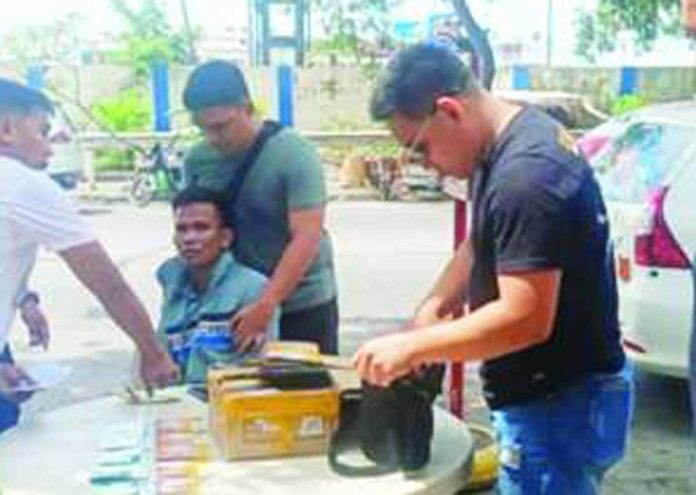
ILOILO City – Authorities raised alarm over potential election sabotage and digital fraud following the seizure of 2,500 pre-registered SIM cards worth P1.25 million from a suspect believed to be supplying tools for online scams and vote buying.
The suspect, a 27-year-old online seller from Leyte identified only as “Nonoy”, was arrested in a sting operation conducted by the Regional Anti-Cybercrime Unit (RACU) 6 at Fort San Pedro here.
Police said the SIM cards were being sold on social media platforms, including Facebook Marketplace, for P500 each — a direct violation of Republic Act (RA) 11934 or the SIM Registration Act.
“These SIM cards can easily be exploited for phishing, identity fraud, and online vote buying,” warned Police Colonel Timmar Alam, chief of RACU 6. “They allow perpetrators to hide behind fake identities, which is exactly what the law aims to prevent.”
Authorities said the suspect had been under surveillance for two weeks prior to the entrapment, during which his digital footprints were carefully traced through online transactions.
The Commission on Elections (Comelec) also weighed in, citing grave concerns about the potential use of the seized SIM cards for digital vote buying in the lead-up to the May 12 national and local elections.
“We are deeply alarmed,” said Atty. Reinier Layson, Iloilo Provincial Election Supervisor. “This undermines the integrity of the electoral process. These SIMs could facilitate massive online vote buying or illegal campaigning without accountability.”
Layson admitted that Comelec currently lacks a specialized unit to monitor such cyber threats but said the matter will be elevated to the inter-agency “Kontra Bigay” task force for further action.
“Nonoy” is now facing charges under both the SIM Registration Act and the Cybercrime Prevention Act of 2012. Authorities are continuing their investigation to determine whether he is part of a larger criminal syndicate.
Under RA 11934, it is unlawful to sell or distribute registered SIM cards, especially due to the risk of criminal misuse and the circumvention of identity safeguards.
As digital manipulation becomes increasingly sophisticated, law enforcement and election officials say the public must remain vigilant — and report any suspicious activities involving SIM card sales or online vote solicitation.
Early this week, Comelec in Iloilo admitted it is grappling with digital vote-buying — a fast-evolving challenge that threatens the integrity of the electoral process. According to Layson, traditional cash hand-outs are increasingly being replaced by online fund transfers using mobile wallets and banking apps, making detection and prosecution more difficult for election watchdogs and law enforcement agencies.
“If elections have become modernized through automated counting and electronic transmission of results, vote-buying has also gone digital,” Layson said. “Now, money is exchanged electronically — something extremely difficult to trace or prove.”
Despite the sophistication of this illegal tactic, Layson said the Comelec remains determined to combat vote-buying and vote-selling through the reactivation of its Committee on Kontra Bigay. This body investigates complaints and encourages citizens to formally report such incidents with supporting evidence.
“So far, we haven’t received any formal complaints on vote-buying in Iloilo, but we expect reports to come in as election day nears,” Layson noted.
To strengthen surveillance, the Comelec has also partnered with the Bangko Sentral ng Pilipinas and other technology-related government agencies. Still, privacy protections on financial transactions remain a barrier to tracking illicit transfers.
Layson explained that often, tip-offs about vote-buying arrive too late.
“By the time our personnel or the police arrive, the actual exchange of money is no longer happening, making it hard to act on mere reports without evidence,” he said./PN