


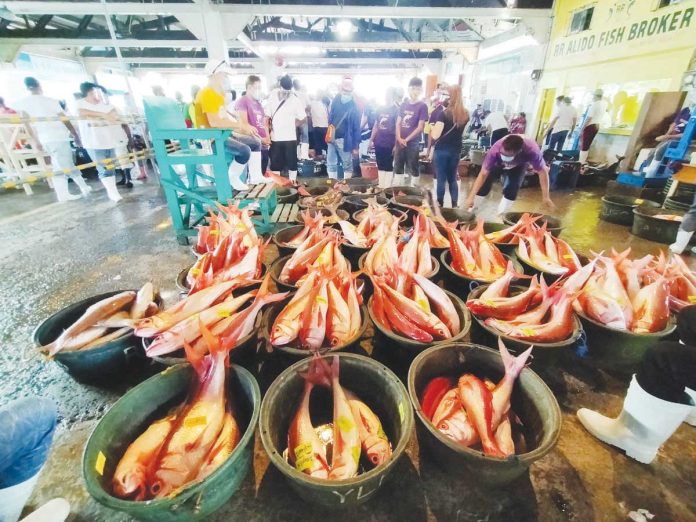
ILOILO City – While Western Visayas boasts an impressive 117% fish sufficiency level and a 14.1% increase in fisheries production in the first quarter of 2025, the Bureau of Fisheries and Aquatic Resources (BFAR) warns that these gains are at risk if marine ecosystems continue to be abused and mismanaged.
Based on preliminary data from the Philippine Statistics Authority (PSA), the region’s fisheries production rose to 59,786 metric tons from 52,415 metric tons in the same period last year, signaling a robust sector.
However, BFAR Region 6 director Remia Aparri emphasized that this success is closely tied to sustainable practices and that ocean protection should be everyone’s responsibility — not just fisherfolk.
“Challenges in aquaculture include climate change, which raises temperatures, and illegal fishing. Everyone — fisherfolk, municipalities, and commercial groups — needs to be aware of these issues. We all share the responsibility for managing fish stocks sustainably,” Aparri stressed.
She pointed out that illegal activities threaten crucial marine habitats, such as mangroves, seagrasses, and coral reefs.
“If these areas disappear, we will lose fish. It is vital to address these challenges for the future of aquaculture,” said Aparri.
Antique led aquaculture production with 22,778 metric tons (MT), followed by Capiz (8,088 MT), Iloilo (3,458 MT), Aklan (789 MT), and Guimaras (652 MT).
Aparri also attributed part of the production increase to the lifting of the “closed season” in the Visayan Sea, which restricts the catch of sardines, herring (tabagak), and mackerel to allow them to reproduce.
“It’s open season now, which started after the lifting of the closed season on February 16. The purpose of this is to implement a fisheries management strategy aimed at sustaining what we refer to as fisheries. There are three species of fish involved: sardines, herring, and another unspecified species. A closed season has been established for the conservation of sardines and herring in the Visayan Sea,” Aparri explained.
She added: “Ang pinaka-rationale is, during the time of close season, nagadamo ang lupoy or ang mga gagmay nga tabagak, and amo na ang time nga gabihod sila and gabuto sila, so dapat during that time wala sang may manguha sang tatlo ka species, para i-allow mag-grow ang gagmay. And i-allow naton ang mga gabihod nga maka-reproduce at least once in their lifetime, indi nga gabihod siya gin dakop dayon.”
“Allowing them to reproduce will contribute to the population of their species in the sea, ensuring that we continue to have these vital fish in the Visayan Sea. This strategy is not merely a standalone approach for fishermen; we should also focus on marine protected area management and observation,” explained Aparri.
Aparri cited scientific data showing a rise in herring production in 2020 during the implementation of the closed season, proving its effectiveness.
She also called for better governance in ocean management, saying, “Governance is a challenge not only ni LGU (local government units), but in different levels nga dapat ang mga policy, mga plano regarding policy and management ma-implement. It’s not only BFAR’s mandate and tasks but is everybody’s concern nga tanan kita magbuylog kag indi naton pag abusaran ang aton pagpangisda, amligan naton ang aton critical habitats.”
In celebration of Ocean Month this May, BFAR also held several community outreach events.
“One notable event is Fisherfolk Day, celebrated on May 26 in Antique, where we gathered local fishermen and provided services like dental care, medical care, haircuts, and medicine distribution with the help of the Bureau of Fishery and Aquatic Resources (BFAR),” said Aparri.
She added that this effort was supported by local government units: “The goal is to honor the fisherfolk in May so they know that government services are available to them.”
As part of Ocean Month, the BFAR director called on the public to embrace environmental stewardship.
“As always, I invite everyone — not just the fisherfolks and LGUs — to join us in celebrating our connection to the ocean. We are blessed with an abundance of fish and other seafood that support our food, livelihoods, and education. Water is the most vital element in the ocean, and in return for its bounty, we have a responsibility to protect it rather than exploit it,” said Aparri. “Indi lang subong kita nga month ga-celebrate. Everyday should be Ocean Day para every day we will be protecting our ocean.”/PN