


ILOILO City – A planned P150-million footbridge across the Iloilo River is drawing fierce backlash, with critics warning it could wreck the river’s fragile ecosystem and tarnish a heritage site that has become a symbol of the city’s identity.
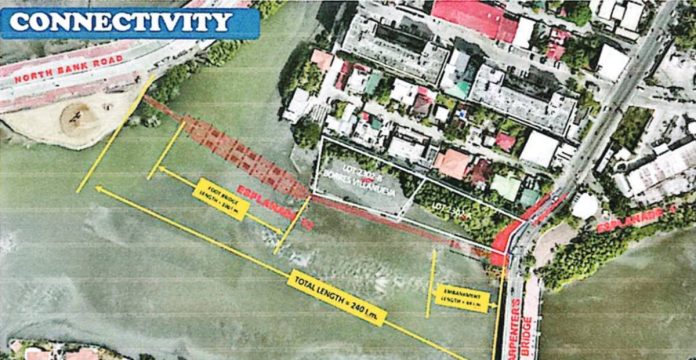
The Department of Public Works and Highways’ (DPWH) Esplanade 12 project, intended to connect the North Bank Road (Sunset Boulevard) and Carpenter’s Bridge in Mandurriao district, is being assailed as both redundant and destructive.
Opponents pointed out that Iloilo already has 11 river crossings, including the nearby Carpenter’s Bridge that fulfills the same purpose.
“This proposed footbridge is unnecessary since there is already a crossing at the other side, the old Carpenter’s Bridge, which serves the same purpose,” Mayor Raisa Treñas said in a September 4, 2025 letter to DPWH Secretary Vince Dizon.
The controversy comes at a time when the Iloilo River itself is increasingly recognized as far more than just a waterway. Despite its name, the river is technically an estuary — an “arm of the sea” — where fresh water from creeks and tributaries mingles with salt water from the Iloilo Strait. This natural system has made it a thriving ecological zone, home to mangroves, mudflats, fish, shellfish, and migratory birds.
Stretching about 15 kilometers, the river winds through Iloilo City and has long been central to its growth. Early settlements flourished on its banks, making it the cradle of Iloilo’s colonial port history.
In modern times, it has become both an environmental showcase and a cultural landmark. Rehabilitation efforts, capped by the Esplanade development, have transformed the river into a model of sustainable urban management celebrated worldwide.
Today, it functions as a wellness hub, a tourism magnet, and a civic centerpiece that embodies Iloilo’s balance between progress and stewardship.
It is precisely this dual role — as ecological sanctuary and cultural heritage — that critics say is endangered by the footbridge plan.
Environmental groups flagged potential damage to mangrove zones through “earth-balling,” a practice proven to harm ecosystems, and noted the absence of an Environmental Compliance Certificate or Certificate of Non-Coverage.
“By cutting directly across the river, the project risks damaging its natural flow, endangering biodiversity, and altering a heritage site that has brought pride and recognition to Iloilo,” said Lucy Lynette Ponce Uygongco of the Iloilo River Community, who urged the city to halt the project pending an independent ecological and cultural impact study.
She stressed that the opposition is not about blocking development.
“It is a living ecosystem, a cultural landmark, and a symbol of our people’s identity,” she said. “Do we really need this kind of project at the cost of the river?”
Mayor Treñas echoed those concerns, saying Iloilo’s growth must remain anchored on sustainability. “We firmly believe that infrastructure must not come at the expense of the environment or the well-being of our communities,” she said.
The mayor vowed to uphold Iloilo City’s reputation as a model of sustainable urban development. “We will continue to make sure that the voices of our people are heard and that our river, our city’s lifeline, remains safeguarded,” she added./PN