



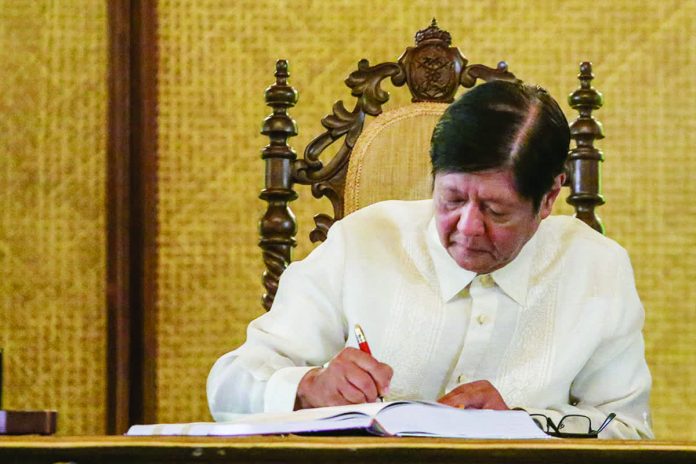
MANILA – President Ferdinand “Bongbong” Marcos Jr. has formally enacted a law that permanently prohibits the operation of Philippine offshore gaming operators (POGOs) in the country, declaring all related activities unlawful.
Under Republic Act (RA) 12312, also known as the Anti-POGO Act of 2025, all offshore gaming activities are now deemed illegal.
The measure, which Marcos signed on October 23, effectively repeals RA 11590 — the law that had previously legalized and regulated POGO operations.
According to the newly signed law, “The State recognizes that the maintenance of peace and order, the protection of life, liberty, and property, and the promotion of the general welfare are paramount for the meaningful enjoyment of democracy. The State likewise values the dignity of every human person and guarantees full respect for human rights.”
It further emphasized, “To this end, offshore gaming operations in the Philippines are hereby banned and declared unlawful.”
The law spells out the total prohibition of setting up, running, or facilitating any form of offshore gaming in the country — including accepting bets, providing gaming content or services, operating hubs, or possessing gaming paraphernalia associated with POGOs.
All previously issued POGO licenses are now permanently cancelled. The Department of Labor and Employment (DOLE) has also revoked all Alien Employment Permits, while the Bureau of Immigration (BI) and other visa-issuing bodies have withdrawn work permits granted to POGO workers.
“Upon the effectivity of this Act, the DOLE, the BI, and other visa-issuing agencies shall not be allowed to issue any visa or work permit to any person for purposes related to offshore gaming operations,” the law stated.
It also mandates the BI to deport any foreign national whose visa has been cancelled “directly to the country of his or her birth or citizenship, in coordination with the appropriate embassy or consulate.”
Despite the termination of their licenses, POGOs and their service providers remain accountable for unpaid taxes, duties, and other government fees up to the last day of their operations.
The Bureau of Internal Revenue (BIR) has been instructed to conduct audits to ensure the collection of these outstanding obligations, with local gaming agents designated as authorized representatives for tax settlements.
Meanwhile, DOLE has been tasked to craft transition and retraining programs for displaced Filipino workers. These initiatives will be developed in partnership with the Technical Education and Skills Development Authority (TESDA), Department of Information and Communications Technology (DICT), Department of Trade and Industry (DTI), and the Commission on Higher Education (CHED) to help affected employees find new employment opportunities.
To oversee implementation, RA 12312 creates an Administrative Oversight Committee (AOC) chaired by the Presidential Anti-Organized Crime Commission (PAOCC), with representatives from the DICT, Department of Justice (DOJ), and Department of the Interior and Local Government (DILG).
The AOC is required to submit a compliance monitoring report to the Office of the President, Senate, and House of Representatives within one year after the law takes effect.
Violators of the Anti-POGO law face severe penalties — imprisonment of up to eight years and fines reaching P15 million for the first offense; up to 10 years and P30 million for the second; and up to 12 years and P50 million for the third.
Public officials found guilty will receive the maximum penalty allowed by law, while foreign offenders will be deported after serving their sentence and permanently barred from re-entry.
RA 12312, which was released to the public on Wednesday, will take effect 15 days after publication in the Official Gazette or a newspaper of general circulation./PN