


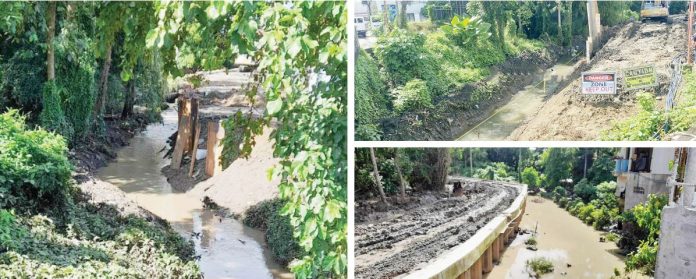
ILOILO City – Reclamation and backfilling activities linked to the construction of the Access Road Section 1 (Bike Lane) Project in Barangay Tagbak, Jaro — which constricted the natural alignment of the Buntatala Creek — have been identified as among the factors that aggravated flooding in five Jaro barangays last July.
This was cited in the results of a site validation and investigation conducted by the Department of Environment and Natural Resources (DENR) – Environmental Management Bureau (EMB) Region 6.
DENR-6 officer-in-charge regional executive director Raul Lorilla, in a letter released on Nov. 25, informed Iloilo City Legal Officer Edward Areño of the investigation about these results after the latter sought clarification from DENR secretary Raphael Lotilla regarding the status, funding, and documentation of the bike lane project, as well as the flood mitigation structure involving the Buntatala Creek. The inquiry stemmed from the severe flooding experienced in barangays Camalig, Lanit, Balantang, Tagbak, and Buntatala — all traversed by the creek.
Both projects, whose fundings were facilitated by the office of Cong. Julienne “Jam-jam” Baronda, are being implemented by the Department of Public Works and Highways (DPWH) – Iloilo City District Engineering Office (ICDEO) under Engr. Roy Pacanan.
According to the EMB-6 Investigating Team, portions of the construction site in Barangay Tagbak were evidently reclaimed, resulting in the narrowing of the creek.
“The backfilling and earth-filling activities further obstructed the natural water flow, eventually leading to the overflow of water onto access roads and adjacent areas,” the findings stated.
The City Legal Office (CLO) noted that under Administrative Order No. 2019-4 of the Philippine Reclamation Authority, reclamation projects are required to undergo several mandatory processes, including feasibility studies; final Environmental Impact Statements (EIS) or equivalent assessments; project descriptions and Initial Environmental Examination (IEE) checklists; area clearances and Environmental Compliance Certificates (ECC); hydrodynamic modeling; and detailed engineering design. None of these preparatory requirements were undertaken for the said projects, the CLO stressed.
The area near the construction site was also where a 13-year-old boy drowned during the severe flooding last July. Initial findings suggested he may have struck a metal rod, resulting in fatal head injuries. The victim was a resident of Zone 3 in Barangay Tagbak.
DENR investigation also showed that a Certificate on Non-Coverage (CNC) had been issued for the flood mitigation structure, but none for the bike lane project. As of Sept. 4, 2025, an online CNC application for the bike lane project remained pending after being returned for lacking requirements.
Other factors contributing to the flooding, based on EMB-6’s investigation, included low elevation and inadequate drainage capacity, vegetation overgrowth and accumulated solid waste obstructing water flow, and intense rainfall from successive tropical cyclones.
RECOMMENDATIONS
The agency recommended that DPWH/ICDEO, in coordination with the local government unit, national government agencies, and civil society organizations, construct slope protection in low-lying areas, subject to required environmental permits (Environmental Compliance Certificate/CNC, tree cutting or earth-balling, if applicable).
The Iloilo City LGU, with concerned agencies, should review future developments using updated topographic and elevation data. They must also update surveys of all waterways and overlay these with the 1950 LC Map as a basis for planning and decision-making.
DPWH is also advised to coordinate all waterway-related infrastructure projects with DENR Region 6 and the Iloilo City LGU.
“Infrastructure project for implementation along waterways shall follow the template adapted on the Iloilo River Esplanade,” the agency cited.
ICDEO must delineate river and creek boundaries to ensure proper alignment and prevent further constriction.
MORE CONTROVERSIAL FLOOD CONTROL PROJECTS
Another project facilitated by the congressional office of Baronda is the controversial P101.32-million flood control project in Lapuz district.
According to Barangay Captain Efren Cenayo of Barangay Don Esteban, the project had no prior consultation with the barangay, nor were barangay officials and residents included in any discussions.
The project was awarded in February 2023 to YPR Gen. Contractor and Construction Supply Inc., a company owned by the controversial contractors Pacifico “Curlee” and Cezarah “Sarah” Discaya.
Aside from this, three projects amounting to P425 million were listed under St. Timothy Construction Corp., and another project worth P150 million under Alpha & Omega General Contractor & Development Corp. — all owned by the Discayas.
Recently, a 600-meter flood mitigation structure in Bo. Obrero — also part of Lapuz — was discovered unfinished, despite its P400-million budget. It was funded through the congressional district office and implemented by the ICDEO.
During President Ferdinand Marcos Jr.’s visit to Iloilo City last August, he criticized the delays and poor implementation of flood control projects after inspecting two flood mitigation projects in Barangay San Isidro in Jaro.
“Sa aking pagbisita sa Iloilo, nakita natin ang mga delayed at palpak na flood control projects na lalo pang nagpapalala ng pagbaha,” Marcos said through his official Facebook page.
He reaffirmed this in a televised press conference last November.
“Noong Agosto, personal kong nainspeksyon ang mga iba’t ibang flood control project. Napunta ako sa Iloilo, nakapunta ako sa Calumpit, at saka sa Baliwag,” he said.
“Doon maliwanag na maliwanag na mga halimbawa ng mga flood control project na hindi tinapos o ghost project talaga, hindi man naumpisahan at naging basehan ng ating tuloy-tuloy na pag-imbestiga,” he added.
The Lone District of Iloilo City is among the congressional districts in Iloilo with the highest “allocables” under the combined 2023–2025 National Expenditure Program (NEP). The city’s congressional office receives P1,351,563,000 in allocables per year, plus an additional P4,054,689,000 from 2023 to 2025.
According to the Philippine Center for Investigative Journalism (PCIJ), allocables “represent a new form of pork because, in the words of the People’s Budget Coalition, they are ‘discretionary, politically motivated,’ and directed toward ‘politically determined projects that crowd out more equitable and accountable public spending.’”/PN