


ILOILO City – A research-driven skincare innovation developed from kadios (pigeon pea) has been granted patent protection, highlighting how years of publicly funded scientific work at a local university have moved from the laboratory toward real-world application.
The patent award and technology licensing agreement for a kadios-based skincare formulation were formalized during a ceremony on Tuesday led by the University of San Agustin (USA) in partnership with Maridan Industries Inc. and Pharma Galen X Inc.
Representatives from the Intellectual Property Office of the Philippines (IPOPHL) Satellite Office in Iloilo City witnessed the event.
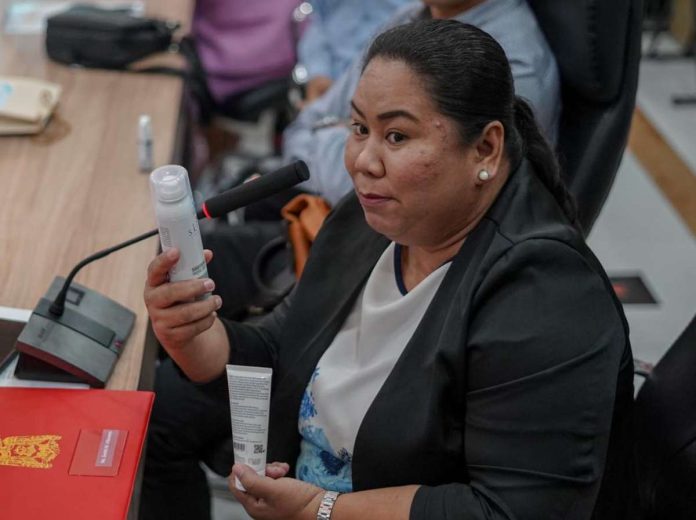
The patented technology centers on a toner facial mist developed from pigeon pea extract, which researchers identified as having antimicrobial and antioxidant properties. The formulation emerged from laboratory studies examining the plant’s potential in addressing skin-related microbial concerns and environmental stress.
Dr. Doralyn Dalisay, director of USA’s Center for Chemical Biology and Biotechnology and lead inventor, said the Skivios patent is the result of nearly a decade of research persistence.
“This patent was conceived way back in 2016. Translating a scientific idea into something tangible requires funding, people, and the right instruments,” Dalisay said.
She recalled that an initial funding proposal submitted in 2018 to a Department of Health-attached agency was rejected.
“As scientists, however, when you have that burning passion to find answers, you pursue it despite rejection,” she said.
The project gained momentum after securing support from the Department of Science and Technology (DOST) in 2019, with funding approved in 2020 at the height of the COVID-19 pandemic.
“Even during the pandemic, while many laboratories stopped operations, our research centers continued working because we committed to deliver results,” Dalisay said.
She noted that preparations for intellectual property protection began even before the project concluded.
The patent application was filed on August 31, 2022, and granted on October 10, 2025, with protection extending until 2042.
“This is not just a patent,” Dalisay said. “It is a science-backed technology meant to serve the people.”
She credited the partnership with private manufacturers and the support of government agencies for enabling the transition from laboratory research to potential commercialization.
Dr. Jonel P. Saludes, USA vice president for research and global relations and one of the inventors, said the work began with a basic scientific question.
“The spark — the scientific question — comes from the university,” Saludes said. “We asked a simple question: what is in kadios that addresses antibiotic or antimicrobial concerns?”
Using DOST-funded laboratories, the research team purified extracts and identified active components, a process that ultimately formed the basis of the patent.
Saludes emphasized that universities alone cannot bring such discoveries to the public.
“We do not have manufacturing plants, and we are not experts in skin formulation,” he said. “That’s where industry partners come in, particularly those with experience in formulation, scaling, and regulatory compliance.”
He added that the kadios-based technology is just one of several innovations under development at the university, including nanotechnology research such as a prototype nanomembrane designed to produce potable water from seawater without electricity.
“These are discoveries waiting for industry adopters,” Saludes said.
University president Arnel S. Dizon, OSA, said the patent reflects USA’s broader shift toward strengthening its research and innovation agenda.
“This places the university not only on the regional but also on the national and international map of science and discovery,” Dizon said. “Through research and innovation, we are engaging beyond our traditional academic boundaries.”
Dizon noted that the kadios-based skincare patent is the university’s first research-driven product to reach the licensing stage and its second collaboration with a pharmaceutical company in Western Visayas.
“In the past, we were known primarily as a traditional teaching institution,” he said. “Now, we are producing research outputs that are translated into solutions through collaboration with government and industry.”
University officials said the achievement underscores the growing strength of local research ecosystems and demonstrates how indigenous resources such as kadios can be harnessed through sustained scientific inquiry, public investment, and responsible knowledge transfer.
Recognized inventors of the patented technology are Dr. Doralyn S. Dalisay, Dr. Jonel P. Saludes, Jan Vincent N. Sollesta, Zenith M. Villorente, Julia Theresa A. Regalado, Jade Joshua Teodosio, Kathryn Ann H. Dizon, Anna Claudia J. Arenas, and Lex Aliko Balid./PN