

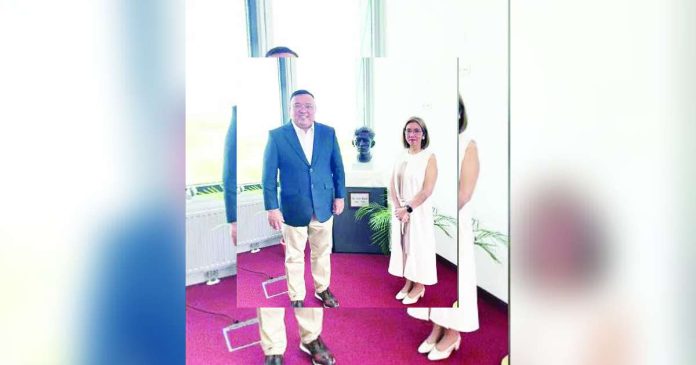
MANILA — Philippine Ambassador to Austria Evangelina Lourdes “Luli” Arroyo-Bernas on Tuesday moved to dispel speculation linking her to former presidential spokesperson Harry Roque, saying she has had no dealings with him since mid-2023 and that a resurfaced photograph of them was taken during an official embassy visit that year.
Arroyo-Bernas said the image circulating online dates back to Roque’s visit to the Philippine Embassy in Vienna with his family and longtime Filipino-Austrian friends, one of whom had donated a Jose Rizal bust displayed at the embassy.
“From what I remember, Mr. Roque came with this Filipino-Austrian family that has been here for a long time. These are his friends from before. The lady wanted to see the bust of Rizal she donated. So, we made sure that there was a proper attribution to her. That was the photo. He came along with this family,” the ambassador said in an interview.
Her clarification came after Palace Press Officer Claire Castro said the photo was not recent, adding that its authenticity and timing had been verified with Department of Foreign Affairs Secretary Maria Theresa Lazaro.
“Patungkol po doon sa larawang nagsi-circulate patungkol po kay Harry Roque at kay Ambassador Luli Arroyo-Bernas, naalarma rin po ako, personal na naalarma ako. Pero noong nakita ko po iyong larawan, mukhang hindi naman po siya iyong kasalukuyang Harry Roque na magri-reflect doon sa picture,” Castro said.
Arroyo-Bernas welcomed the Palace clarification, stressing the need to establish facts to avoid unfair conclusions.
“I am grateful that she actually pointed that out to make sure that when somebody says something, they don’t destroy the reputation of someone who is doing their work without any malice. That you need to know what the facts are.”
Amid questions over Roque’s reported attempt to seek asylum in Austria, the Philippine Embassy in Vienna emphasized that it has no role in immigration or asylum decisions.
“Whether Mr. Roque is allowed to stay in Austria and other parts of Europe without a valid Philippine passport is within the exclusive purview, control, and discretion of Austria and the other countries he visits,” the embassy said in a statement.
The embassy also underscored that Philippine missions abroad have no authority to arrest Filipino nationals.
“The Philippine Embassy in Vienna, as with any other Embassy or Consulate, has no legal authority to effect the arrest of any Filipino national abroad. The extra-territorial execution of any warrant of arrest issued by Philippine courts is a matter of cross-border law enforcement–in particular, mutual legal assistance directly handled by the Department of Justice with its counterpart agency abroad,” the statement read.
Arroyo-Bernas added that European governments strictly enforce privacy laws, particularly in asylum-related cases.
“[That also goes] for any person who is seeking or who has applied for asylum—they will not give us that information,” she said.
“We have to work within the bounds of the laws and treaties that we agreed to. We don’t have a police attaché here, and the embassy does not have police powers. That’s not part of our job. Our job is, as far as assistance to nationals goes, if they are in distress, then they can ask us,” she added./PN