

ILOILO – The Provincial Government Environment and Natural Resources Office (PGENRO) has warned the public against capturing, selling, collecting, or keeping wildlife species as pets — particularly the endangered species collectively known as the “Panay Big 5.”
The reminder came as the Iloilo provincial government joined the observance of World Wildlife Day on March 3, emphasizing the need to protect rare wildlife species that play a crucial role in maintaining the ecological balance of Panay Island.
Forester Mitzi Peñaflorida, head of the Environmental Programs and Management Services Division of PGENRO, stressed that the illegal collection, trade, or destruction of wildlife and their habitats is prohibited under Republic Act No. 9147, also known as the Wildlife Resources Conservation and Protection Act.
The law, enacted in 2001, is the country’s primary legislation for conserving, managing, and protecting wildlife species and their habitats. It regulates the collection, trade, and transport of wildlife and imposes strict penalties, including fines and imprisonment, for violators.
“Bawal gid ang manguha, baligya, dakpon kag himuon pet ang aton mga wildlife kag gub-on ila habitat kay amo ni sila nagabulig maintain kag preserve ka aton biodiversity. They have roles sa aton ecosystem,” Peñaflorida told Panay News.
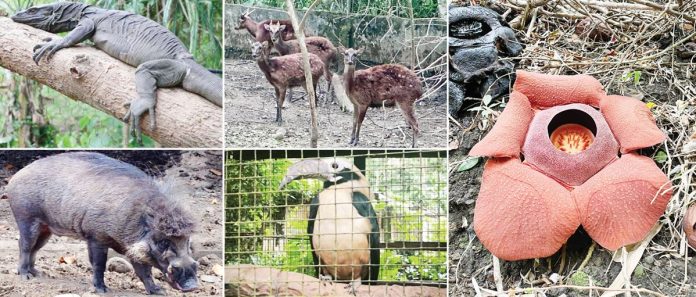
The so‑called “Panay Big 5,” a group of rare animals and plants considered vital to the island’s biodiversity.
One of these is the Panay monitor lizard (Varanus mabitang), an endangered species found only on Panay Island. Unlike most monitor lizards, it primarily feeds on fruits and lives high in the forest canopy.
The species inhabits remaining forest areas in the northwestern and western mountain ranges at elevations of around 200 to 1,000 meters and relies heavily on primary forest ecosystems. Its low population density makes it particularly vulnerable to overhunting and habitat loss.
Another species is Rafflesia speciosa, locally known as uruy, kalo posong, or agong‑ong in the Karay‑a language. It is one of the largest Rafflesia species in the Philippines.
While initially believed to exist only on Panay Island, photographic evidence suggests it may also be found on the lower slopes of Mount Canlaon in Negros.
The plant thrives in lowland secondary forests at elevations of 190 to 800 meters, typically growing in well‑drained soils under thick leaf litter.
Also included in the Panay Big 5 is the Walden’s hornbill (Rhabdotorrhinus waldeni), locally known as dulungan. The bird is now believed to survive only in Negros and Panay after becoming extinct in Guimaras.
Recent studies estimate that fewer than 160 individuals remain, although surveys in the Central Panay Mountain Range suggest around 600 to 700 pairs may still exist.
Hornbills are monogamous and rely on large dipterocarp trees for nesting. During breeding, the female seals herself inside a tree cavity while the male provides food for the female and their chicks.
Another rare species is the Visayan spotted deer (Rusa alfredi), also known as Prince Alfred’s deer. The animal is found only in the rainforests of Panay and Negros.
It typically inhabits dense cogon grasslands and both primary and secondary forests. The deer is nocturnal and emerges at dusk to feed, quickly retreating into dense vegetation when threatened.
Completing the group is the Visayan warty pig (Sus cebifrons), a species endemic to the Western Visayas. It once thrived in forests from sea level to mossy mountain forests but has seen its population decline due to habitat destruction and hunting.
The species is known for its social behavior, often foraging in family groups while communicating through squeaks, grunts, and chirping sounds.
According to PGENRO, sightings of these wildlife species have been reported in upland areas of the municipalities of Calinog, Lambunao, and Janiuay in Iloilo, as well as in neighboring provinces such as Antique and Aklan.
Peñaflorida explained that wildlife animals commonly rescued — such as birds — are usually turned over to the Municipal Environment and Natural Resources Office (MENRO), which then coordinates with the Department of Environment and Natural Resources (DENR) for proper handling and eventual release back into the wild.
If animals are injured, they may be brought to authorized wildlife facilities with permits to operate, including the Mari‑it Wildlife and Conservation Park in Lambunao, Garin Farm in San Joaquin, and Ranger Farm in Sara.
Authorities are also urging the public to report individuals involved in the illegal possession or sale of wildlife species.
Residents who encounter such activities are encouraged to report them to their local Municipal ENRO so inspections and validation can be conducted, which may lead to the confiscation of illegally held wildlife.
MENRO personnel have been deputized as Bantay Gubat or Wildlife Enforcement Officers, working together with the PGENRO team to monitor and enforce violations of Republic Act No. 9147./PN