



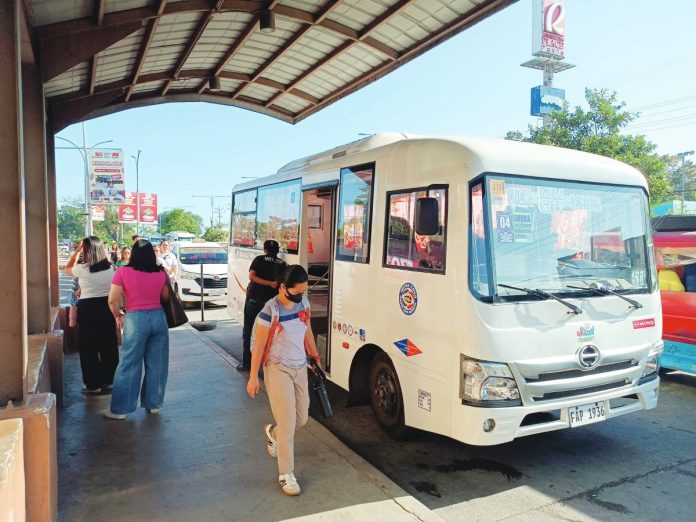
ILOILO City – Soaring fuel prices have forced modern jeepney operators here to slash trips across major routes, with some cooperatives warning of a possible total shutdown if government intervention does not come swiftly.
Transport cooperatives and corporations operating modern jeepneys have begun limiting the number of units deployed per route as continued increases in petroleum prices eat into already thin earnings.
The Western Visayas Transport Cooperative (WVTC), for instance, further reduced its operating units starting Tuesday, April 7, after diesel prices reportedly surged to as high as P160 per liter.
“Last week nagbuhin kita for 50/50. Subong daw indi na gid ma-agwantahan. Amu na nga nag-board meeting ta. Ginatun-an namon kun ano gid ang maayo sa operation namon nga indi man matam-an ang amon nga coop. Subong gapanabon na si coop kay ang kita namon gasulod lang sa diesel namon,” said WVTC president Raymundo “Boyet” Parcon.
From deploying about 50 percent of its 95 modern jeepney units last week, WVTC has further scaled down operations. On the Jaro CPU route, units dropped from 20 to eight; Ungka (ITGSI) from 15 to seven; Mohon Terminal routes now operate at half of 13 units; and Tagbak Terminal routes plunged from 30 units to just five.
Parcon said the cooperative could no longer sustain mounting losses, noting that even before the latest fuel hikes, daily fuel expenses per unit ranged from P2,500 to P2,700. This has now ballooned to around P5,000, and could reach P6,000 with the latest increases.
“Ang kita namon P6,000. Ang pinakataas na, P6,500,” Parcon lamented.
With revenues barely covering fuel costs and additional expenses such as driver and Passenger Assistance Officer (PAO) salaries, operators are now operating at a loss while still paying off bank loans for their units.
To cushion the impact on drivers and PAOs affected by reduced trips, WVTC has implemented a rotation scheme to ensure they still earn weekly income.
Parcon urged the government to immediately implement fare adjustments and release financial assistance.
“I-suspend man ang excise tax on fuel,” he added.
Parcon warned that without urgent government action, WVTC may be forced to cease operations entirely.
“Nakita ninyo ang sitwasyon namon subong. Indi gid namon kaya baklon ang diesel. Sa adlaw-adlaw nga tanan gapanabon na kami sa amon empleyado kag driver.Ti, intindehon lang ninyo kag kabay pa buligan ninyo kami sa pagpanawagan sa gobyerno,” Parcon said.
Other transport groups are also taking similar steps.
The Metro Iloilo Transport Services Cooperative (MITSCOOP) held an emergency meeting on April 7 to map out strategies to sustain operations amid rising fuel costs.
Meanwhile, the Alliance of Provincial Operators and Drivers Transport Cooperative (APODTC) and Calumpang-Iloilo Transport Service Cooperative (CITSCO) have already reduced their deployed units.
APODTC cut units on the Mohon–ISAT-U route from 15 to eight, while CITSCO now rotates five units on the Mohon–Mandurriao–Megaworld route from a previous 10.
Operators also cited declining passenger volume, as most schools are now on vacation, further compounding losses.
The transport sector warned that without immediate relief measures, commuters may soon face even fewer transport options as operators struggle to stay afloat./PN