



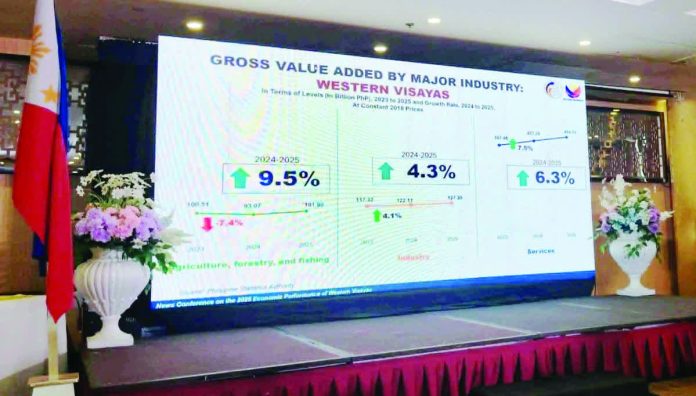
ILOILO City – Western Visayas’ agriculture, forestry, and fishing (AFF) sector staged a dramatic turnaround in 2025, posting a 9.5-percent growth from a steep -7.4-percent contraction in 2024, but economic managers warned that rising fuel costs and global geopolitical tensions could derail gains and trigger food security risks in 2026.
As global economic uncertainties escalate due to tensions in the Middle East, it is hoped that the sector can sustain its recovery even as vulnerabilities persist.
AFF staged a remarkable recovery in 2025, with projected growth soaring to 9.5% following a steep contraction of -7.4% in 2024, according to the Philippine Statistics Authority (PSA) and the Department of Economy, Planning, and Development (DEPDev).
The agriculture and fisheries industries are particularly susceptible to fluctuations in the global market, most notably due to rising fuel prices triggered by ongoing geopolitical conflicts in the Middle East.
These price hikes have led to a grim forecast for 2026, characterized by rapid inflation, significant disruptions to supply chains, and widespread economic instability.
In the Philippines, diesel prices have surged beyond P150 per liter, forcing essential transportation services to halt and creating alarming shortages in agricultural supplies.
This combination of factors poses a serious threat to food security, raising concerns about potential food scarcity as logistics falter.
To counter these challenges, the Philippine government has enacted several proactive measures aimed at supporting the agricultural sector.
Engr. Arecio Casing Jr., the Western Visayas director for DEPDev, highlighted the ongoing efforts associated with the government’s Uplift Program, which has enabled the Department of Agriculture to roll out crucial subsidies for farmers and fisherfolk.
“These initiatives demonstrate a focused commitment to ensuring that our agricultural producers receive the necessary support. However, our success hinges on other factors as well,” he noted.
“We must also pray for good weather conditions that favorably impact crop production. Adverse weather events—whether excessive heat or floods—can significantly disrupt yields,” Casing said.
Moreover, Regional Director Nelida Amolar of PSA emphasized the critical interplay between agriculture and environmental conditions.
“We cannot underestimate the role of favorable weather in sustaining agricultural output. The impact of climate anomalies can severely hinder our capabilities if we experience extreme conditions,” Amolar warned.
“Therefore, it’s essential that we remain vigilant and adaptive,” she said.
“With the help of the national support and the DA, hopeful pwede naton ma-sustain. Also with the help of, let’s pray for the good weather to cooperate with our farmers and for our production of our crops, if sobra naman ka init and may baha, they are all affected. Let’s pray for a good weather to mitigate these risks and pag reduce sang aton production in terms of agricultural products,” she added.
Casing also depicted the regional economy’s structure, which comprises five provinces and one highly urbanized city. He explained that the economic rejuvenation observed in the region has been significantly influenced by the activities and innovations from these localities.
“The provincial contributions have been instrumental in driving growth within our regional economy,” he stated.
Despite the optimistic outlook for 2025, both Casing and Amolar voiced caution regarding predictions for 2026.
“At present, we lack concrete forecasts for 2026, as the data collection for Gross Regional Domestic Product (GRDP) is ongoing. We do remain hopeful that things will stabilize, particularly concerning inflation and employment rates,” Amolar indicated, acknowledging the combined efforts of multiple implementing agencies in striving for economic resilience.
This anticipated resurgence not only highlights the resilience of these critical sectors but also underscores the challenges posed by escalating global crises, particularly the geopolitical tensions affecting fuel prices and supply chains.
Furthermore, Casing also raised alarms about the immediate ramifications of the ongoing crisis on consumer behavior and spending patterns.
“We are seeing demand destruction manifest in various ways. People are traveling less and postponing consumption choices. These initial effects are just the tip of the iceberg,” he remarked. “However, we are also witnessing a noteworthy shift towards increased investments in renewable energy, particularly solar power, as various government sectors adapt to these challenges.””
Casing emphasized the importance of local production and consumption, suggesting that these changes could provide a foundation for recovery in 2026, even in the face of potential economic adversity.
As the agriculture, forestry, and fishing sectors ready themselves for what could be a historic rebound, stakeholders are committed to navigating the complexities introduced by the global crisis.
The progress witnessed in essential crop production — including rice, corn, and sugarcane — provides a substantial opportunity for the Philippines to not only recover but also innovate within its agricultural practices.
Western Visayas was the fastest-growing regional economy in the Philippines in 2025, expanding by 6.4% with a significant rebound in agriculture, strong industry performance, and resilient consumer demand. Following 4.4% growth in 2024, indicating renewed economic momentum despite global uncertainties.
“With the help and support of the other implementing agencies, hopefully, we will sustain, but the forecast we cannot tell even the inflation in these coming months,” Amolar stressed./PN