


ILOILO City – The Department of Agriculture (DA) in Western Visayas has stepped up market inspections to enforce the government’s P50-per-kilo price ceiling on imported rice while simultaneously investigating possible irregularities in the rice supply chain that may be affecting retail prices and undermining local farmers.
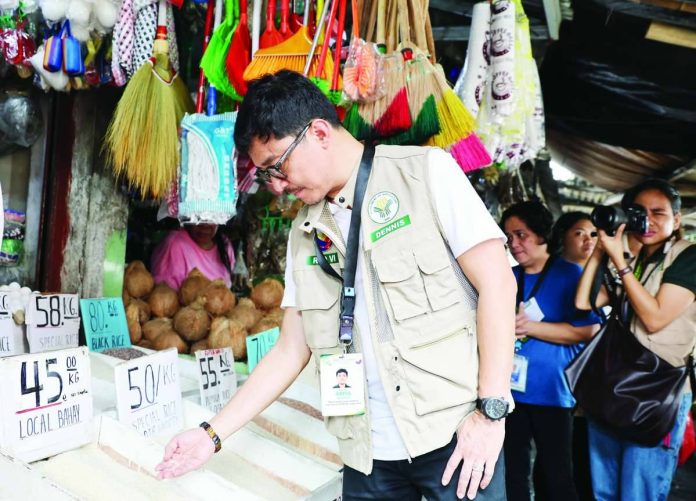
Led by Regional Executive Director Dennis Arpia, inspection teams conducted compliance checks at La Paz Market and Jaro Small Market in Iloilo City on June 1, accompanied by representatives from the National Food Authority (NFA), Bureau of Plant Industry (BAI), Department of Trade and Industry (DTI), Department of the Interior and Local Government (DILG), and the Philippine National Police (PNP).
The intensified monitoring forms part of the implementation of Executive Order No. 118, which imposes a P50-per-kilogram price cap on 5-percent broken imported rice. Authorities said the inspections are intended not only to ensure compliance but also to gather information that could shape future rice pricing policies and market interventions.
Arpia said the government is using the implementation period to better understand rice marketing and pricing dynamics across regions.
He noted that consultations with retailers, traders, and other stakeholders are ongoing to identify concerns and collect feedback on the policy’s impact.
The DA also seeks to determine how rice moves through the supply chain and whether price manipulation exists at any stage of the value chain.
“Hihingan kayo namin ng mga information para masundan natin kasi po ang dulo nito, bukod sa pinoprotektahan natin ang mga konsyumer natin, kawawa din po ang ating mga magsasaka,” Arpia told retailers during a consultation.
According to Arpia, Western Visayas remains more than 100 percent sufficient in local rice production, but many farmers continue to struggle because consumers often prefer imported rice while some millers find imported stocks easier and more profitable to trade than locally produced palay.
“Ayaw po natin na mangyari na ma-hostage tayo sa huli ng mataas na presyo ng imported rice dahil wala na tayong mapagkukunan ng lokal na bigas dahil napagod na ang ating mga farmers,” he said.
The DA chief said sustaining local rice production is essential to ensuring long-term food security and protecting consumers from future price shocks.
Agriculture officials acknowledged that some pricing irregularities may stem from inefficiencies in the supply chain, while others could result from deliberate market practices that warrant closer scrutiny and stricter enforcement of existing regulations.
“In many cases, we are also constrained by weaknesses within the value chain. These gaps need to be clearly identified, particularly on the production side, so that when policies are enforced, the intended benefits reach both farmers and consumers,” Arpia said during a meeting with partner agencies.
Meanwhile, the DA urged consumers to support locally produced rice, saying stronger demand for local varieties would improve farmer incomes and strengthen the region’s agricultural sector.
He added that the agency plans to consult retailers to identify rice varieties preferred by consumers so local farmers can align production with market demand.
The DA also cited measures aimed at protecting local producers, including restrictions imposed by Agriculture Secretary Francisco P. Tiu Laurel Jr. on the entry of imported rice through Western Visayas ports during local harvest periods to shield farmers from the effects of excessive importation./PN