



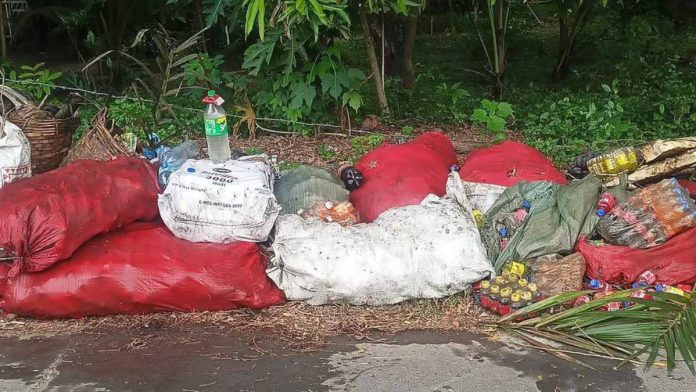
ILOILO City – The city government will file criminal charges against a Chinese-Filipino businessman over the alleged dumping of dozens of sacks of expired beverage products into the Jaro River, and also move to revoke his business permit.
The planned legal action marks a major breakthrough in the city’s Oplan Kontra Baha campaign targeting waste clogging waterways.
Engineer Neil Ravena, head of the city government’s General Services Office (GSO), said complaints for violations of Republic Act (RA) No. 9003, or the Ecological Solid Waste Management Act of 2000, and RA No. 9275, or the Philippine Clean Water Act of 2004, are being prepared following a technical conference held Thursday, June 18, with concerned stakeholders.
The businessman owns a depot that authorities traced to sacks of expired products recently recovered from the river.
Ravena said representatives from the Department of Environment and Natural Resources (DENR), barangay officials, the Business Permits and Licensing Office (BPLO), GSO, and the City Environment and Natural Resources Office (CENRO) attended the technical conference to verify reports and allow the respondent to explain how expired commodities ended up in the Jaro River.
During the conference, Ravena said the businessman claimed he was repacking expired products into sacks in preparation for their return to the distributor of a bottling company.
However, Ravena questioned the explanation.
“Usually when you return bad orders, you do not remove them from their original packaging or boxes. The same boxes are retrieved by the distributor. In this case, the products had already been transferred into sacks,” he said.
According to Ravena, the sacks recovered in Barangays Ticud and Baldoza were identical to those found in the businessman’s depot, allowing authorities to trace the source of the dumped products.
He added that the businessman initially admitted ownership of the recovered sacks based on the packaging but later claimed he had left them outside his depot and that unidentified tricycle drivers allegedly took and dumped them without his knowledge.
While the businessman presented CCTV footage showing a driver taking a sack, Ravena said authorities were “not convinced” by the explanation.
“Even if you claim it was done without your knowledge, these are expired food products. As the business owner handling these items, and since the products were issued to you by the bottling company, responsibility for their disposal rests with you,” Ravena said.
He stressed that under RA 9003, commercial waste generators are accountable for the proper disposal of their waste.
“If you generated it, it is your responsibility. Otherwise, you should properly return the expired products to the bottling company,” he added.
Ravena warned that improper disposal of expired products poses serious environmental and public health risks, including contamination of waterways and the possibility that discarded products could be recovered and resold despite being unfit for consumption.
Authorities learned from the businessman’s own account that 67 sacks of expired products had already been removed from the depot, while approximately 500 more sacks remain stored at the facility.
Ravena said a portion of the 67 sacks has already been recovered from the river, although clearing operations continue. GSO personnel have been retrieving six to eight sacks from the river daily, with 15 sacks recovered on the most recent day of operations.
“Why would you place them outside your property if you intended to return them? There are inconsistencies in his statements,” Ravena said.
The depot has reportedly been operating in Iloilo City for nearly two years.
Ravena said authorities cannot rule out the possibility that this was not the first time waste from the establishment had been dumped into the Jaro River.
Apart from filing charges, the city government will recommend the revocation of the businessman’s business permit.
Ravena disclosed that while the establishment possesses a valid business permit, it lacks environmental compliance documents such as a Certificate of Non-Coverage (CNC) and an Environmental Compliance Certificate (ECC).
He added that the barangay clearance issued to the businessman has already been revoked.
To prevent the remaining 500 sacks from being dumped into the river, the city government has offered to dispose of the expired products on behalf of the owner, subject to the payment of disposal and garbage fees.
“Coordinate with us because we can provide advice and ensure proper disposal mechanisms for these products,” Ravena said, urging businesses facing waste disposal issues to seek assistance from the city government./PN