


BACOLOD City — The Department of Agriculture (DA) has intensified efforts to combat the rapidly spreading red-striped soft scale insect (RSSI) as sugar industry leaders, Negros Occidental officials, and the Sugar Regulatory Administration (SRA) prepare to meet today, June 23, to strengthen measures against the pest threatening the country’s sugar sector.
During the recent 40th anniversary celebration of the SRA, Agriculture Secretary Francisco P. Tiu Laurel Jr. directed the agency to accelerate the mass production of biological control agents using naturally occurring fungi to suppress the pest before it causes further damage to sugarcane plantations.
“I told the SRA to address the RSSI infestation head-on. We have the technology and the capability to produce the biocontrol agent to do so,” Tiu Laurel said.
He said the government aims to produce enough biological control agents to cover at least 75,000 hectares of sugarcane plantations nationwide.
The agriculture chief also pledged additional funding to support expanded production of biocontrol fungi, develop artificial intelligence-based technologies for early pest detection, and maximize the use of laboratories under the Bureau of Plant Industry and other DA facilities.
The intensified response comes as the latest SRA monitoring report, dated June 11, shows RSSI has entered an accelerated phase of infestation across the Visayas.
A total of 4,847.63 hectares of sugarcane plantations in five provinces have been affected, impacting 2,587 farmers in 244 barangays.
Southern Negros Occidental remains the hardest-hit area, with 2,429.62 hectares infested across 74 barangays, affecting 1,399 farmers. Another 1,400.52 hectares have been affected in central and northern Negros Occidental, while 797.71 hectares have been recorded in Negros Oriental.
The infestation has likewise spread to 197.60 hectares in Iloilo, 22.03 hectares in Capiz, and 0.15 hectare in Leyte, where the first confirmed case has been recorded.
The SRA identified Mabinay in Negros Oriental and the Negros Occidental towns of Himamaylan and Binalbagan as major RSSI hotspots.
“The June 11, 2026 report demonstrates that RSSI has entered a phase of accelerated infestation in the Visayas,” the SRA said, noting that the emergence of new hotspots underscores both the severity of the outbreak and intensified monitoring efforts.
Amid the worsening situation, the United Sugar Producers Federation (UNIFED) has organized a high-level meeting on June 23 that will gather Governor Eugenio Jose Lacson, members of the Sangguniang Panlalawigan, SRA officials, and the Inter-Agency RSSI Task Force to discuss immediate interventions and support for affected farmers.
UNIFED President Manuel Lamata described the infestation as increasingly alarming, saying affected areas have been doubling almost every week.
“The figures are alarming, doubling on a weekly basis, and our planters, particularly the small farmers, are worried about what this massive infestation will do to our crops,” Lamata said.
Although RSSI was first detected in local sugar-producing areas last year, Lamata said the current outbreak is far more severe.
“It came in while our sugar crops were already standing and although it has done some damage, what we are seeing now is worse than what we witnessed last year and this needs intervention from all sectors, both government and private,” he said.
Lamata warned that the infestation could have serious economic consequences for Negros Island, where thousands of livelihoods depend on the sugar industry.
“Sugar is the lifeblood of Negros Island, and we suspect that RSSI has caused the drop in last year’s production. We fear that if this is not addressed, it will cause even bigger damage,” he said.
He also acknowledged the SRA’s continuing research and assistance to farmers but noted that the agency faces constraints in manpower and resources.
“SRA has continuing research on RSSI, as well as continuing assistance to farmers, but they can only do so much in cultivating fungi and other natural scientific approaches to combat RSSI. They also lack the resources and manpower to fully cover the entire island and validate the extent of the damage,” Lamata said.
He stressed that a coordinated response involving both government and the private sector is essential to protect the industry’s productivity and long-term sustainability.
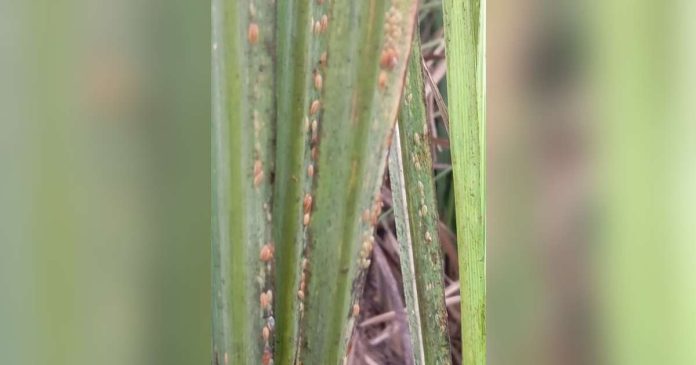
RSSI, a sap-sucking insect first detected in the Philippines in 2022, can reduce the sugar content of infected cane by as much as 50 percent while promoting the growth of sooty mold that further hampers photosynthesis and crop development.
The SRA has allocated about P8 million for mitigation efforts and has led the Inter-Agency RSSI Task Force since its creation in 2025, promoting science-based and environmentally sustainable pest management strategies to safeguard domestic sugar production./PN