



ILOILO — While adolescent live births in Western Visayas slightly declined in 2024, the Commission on Population and Development (CPD) has raised the alarm over the rapidly increasing pregnancies among girls aged 10 to 14, describing the trend as the region’s most urgent concern requiring immediate intervention from families, schools, and communities.
Latest data from the Philippine Statistics Authority (PSA), cited by CPD Region 6, showed that Western Visayas recorded 4,867 adolescent live births in 2024, marginally lower than the 4,875 registered in 2023. The figures exclude Negros Occidental and Bacolod City.
Iloilo Province accounted for the highest number of adolescent live births with 2,226, followed by Capiz (866), Aklan (722), Antique (464), Iloilo City (352), and Guimaras (237).
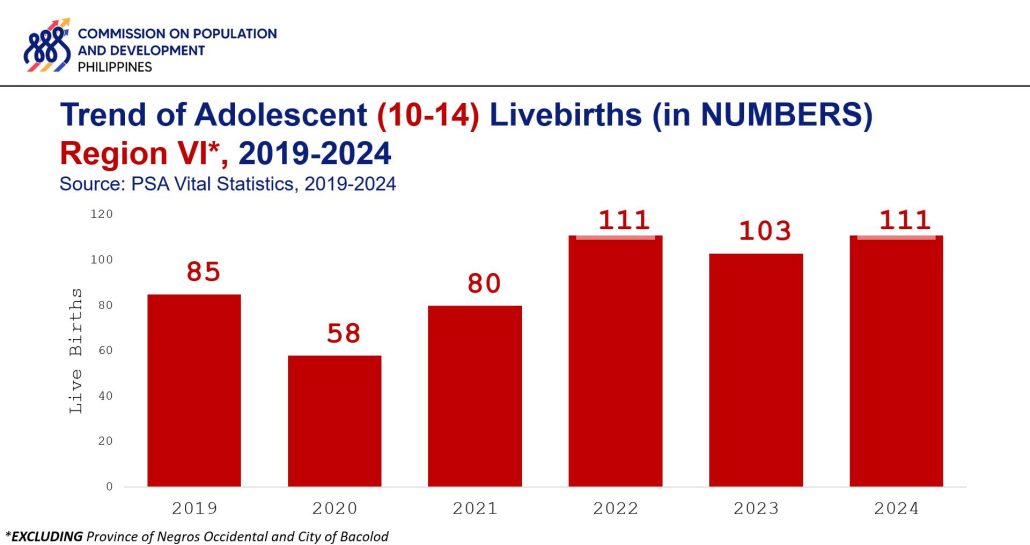
Although births among adolescents aged 15 to 19 continue to comprise the overwhelming majority at 4,756, CPD-6 emphasized that the faster-growing trend involves children aged 10 to 14, who accounted for 111 live births in 2024.
According to CPD-6 regional director Harold Alfred Marshall, the shift is deeply concerning because pregnancies are occurring among much younger children.
Historical data showed births among girls aged 10-14 rose from 85 in 2019 to 111 in 2024, while births among those aged 15-19 generally declined from 5,971 in 2019 to 4,756 in 2024.
“That would be ang focus sang aton mga programa now… Abi naton, amo ni nga kabataan ara sa eskwelahan, kay gali may buot na sila,” Marshall said.
Marshall attributed the increase largely to inadequate parental guidance and the lack of timely and accurate sexual and reproductive health education, noting that many adolescents instead rely on peers for information.
“Parents provide the foundational guidance for responsible parenthood, but they cannot always be present to oversee their children,” he noted.
Marshall added: “Kakulangan man sa gihapon sa information and proper kag relevant and timely nga information. And if we’re talking about sa responsibility sang ginikanan, we also want to point out ang responsibility man sang community mismo. Amo bala inang hambal nila nga ‘it takes a village to raise a child’. Everybody has to be involved whether it’s family and community, and mismo ang barkada mo, nga ikaw man mismo kabalo magpili sang barkada mo.”
“They really need parental guidance. Kay ti, indi sa tanan nga oras ara ang ginikanan. Magtulog ang ginikanan, ining mga bata kaisa gataklas sa bintana para mag upod sa ila mga barkada, naga-text-sanay mag-gang war,” he stressed.
CPD-6 also cited a significant knowledge gap among young people regarding sexual and reproductive health and called for expanded educational programs targeting both the 10-14 and 15-19 age groups.
“To combat this issue, we need programs that address both the 10-14 and 15-19 age groups. It’s not merely about shifting focus away from the older adolescents but ensuring that all young people receive the necessary information and support they need to make informed choices,” Marshall said.
CPD-6 earlier revealed that more than four in every 10 adolescents in Western Visayas have been exposed to online pornographic content, while a growing number are also exchanging sexual images online.
Data from the 2023 Young Adult Fertility and Sexuality Study (YAFS) Regional Profile showed that 41 percent of adolescents aged 10 to 19 in Western Visayas reported accidental exposure to pornographic materials, while 17.6 percent admitted deliberately seeking such content.
The study also found that 38 percent had received sexual photos or videos, and 7.3 percent had sent such materials.
The findings have raised concerns over adolescents’ online safety and the potential effects of digital exposure on their understanding of sex, relationships, consent, and personal privacy.
“Adolescents are now digitally familiar. It is said that they are exposed to pornography, but we need to be very careful because exposure does not necessarily mean they will practice what they see. Causality does not necessarily mean correlation. This is based on findings from their interviews, and these participants are adolescents. Nevertheless, supervision and education remain crucial,” said Marshall./PN