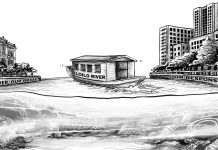




NO LONGER a distant threat, climate change is already reshaping coastlines, intensifying typhoons, accelerating sea-level rise, and exposing thousands of families to greater danger every year. In a country that experiences some of the world’s strongest tropical cyclones, local governments can no longer afford to treat environmental protection as a secondary concern.
This is why the Iloilo City government’s decision to establish 100-meter-wide Coastal Greenbelt Zones in all 32 coastal barangays deserves strong public support. Rather than relying solely on expensive seawalls and concrete engineering projects, the city has chosen to strengthen one of nature’s most effective defense systems — its mangrove forests.
Mangroves – those clusters of trees growing along muddy shorelines – are living infrastructure. They absorb the force of storm surges, reduce coastal erosion, stabilize shorelines, trap carbon, protect marine ecosystems, and provide breeding grounds for fish, crabs, and countless other marine species that sustain the livelihood of coastal communities. Every hectare of healthy mangrove forest performs environmental services that would cost governments millions of pesos to replace with artificial structures.
The Coastal Greenbelt Zone Ordinance recognizes this reality by prohibiting illegal cutting of mangroves, destructive fishing practices, reclamation, unauthorized land conversion, illegal waste disposal, and other activities that have slowly degraded Iloilo City’s coastal ecosystems. Equally important, it establishes a Coastal Greenbelt Zone Committee tasked with implementing a long-term management plan that combines rehabilitation, scientific monitoring, conservation, and community participation.
However, passing an ordinance is only the beginning. The true challenge lies in implementation.
The Philippines has no shortage of well-written environmental laws. Unfortunately, many exist only on paper while illegal cutting, encroachment, reclamation, and environmental destruction continue with little consequence. Iloilo City must not allow this ordinance to suffer the same fate. Strict enforcement should become the standard, not the exception.
Equally critical is sustained funding. Mangrove rehabilitation cannot be accomplished through occasional tree-planting events designed merely for photo opportunities. It requires years of maintenance, monitoring, replacement planting, scientific evaluation, and continuous community engagement. Without adequate financial support, even the best environmental policies eventually lose momentum.
The success of this initiative will also depend on the active participation of coastal residents. Fisherfolk, schools, environmental organizations, businesses, and ordinary citizens must recognize that protecting mangroves is ultimately protecting their own homes, livelihoods, and future. Climate resilience cannot be delegated solely to government agencies.
Perhaps the greatest strength of this ordinance is its emphasis on prevention rather than disaster response. For decades, government spending has largely focused on repairing damaged infrastructure after storms instead of investing in natural systems that reduce damage before disasters strike. Every peso invested in healthy coastal ecosystems today can save many more pesos in future relief operations, infrastructure reconstruction, and economic losses.
Iloilo City has often positioned itself as a leader in urban governance and environmental innovation. This ordinance reinforces that reputation. But leadership will ultimately be measured not by the passage of legislation, but by thriving mangrove forests, healthier fisheries, safer coastal communities, and fewer families displaced whenever powerful storms hit.