



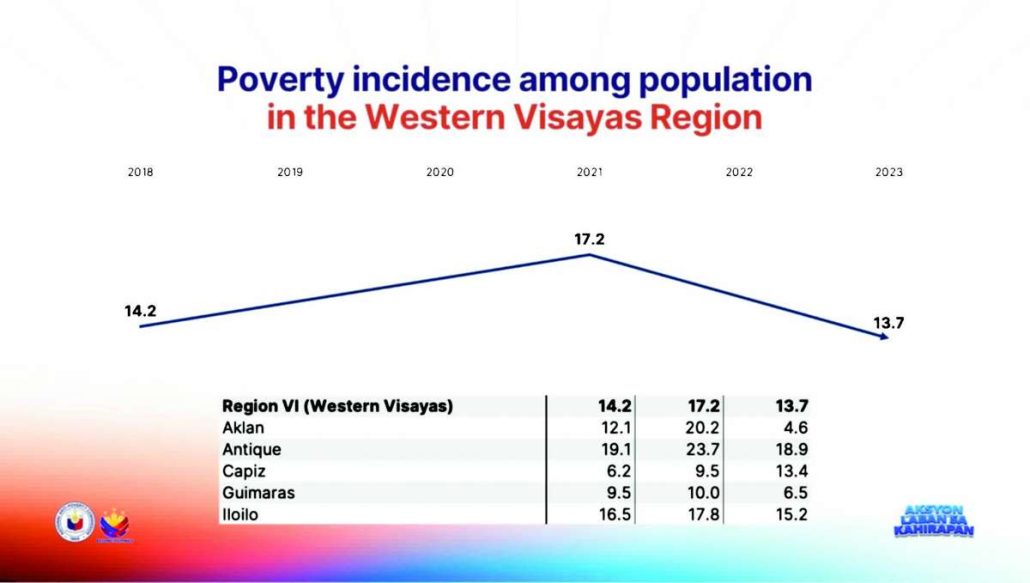
ILOILO CITY – Western Visayas has reduced its poverty incidence to its lowest level in years, with the rate falling to 13.7 percent in 2023 — below both the national average of 15.5 percent and the region’s pre-pandemic level — signaling a strong economic rebound driven by improved employment and sustained poverty reduction efforts, according to the National Anti-Poverty Commission (NAPC).
The latest NAPC data showed the region’s poverty incidence dropped sharply from 17.2 percent in 2021 and 14.2 percent in 2018, reversing the spike recorded during the height of the COVID-19 pandemic.
The agency said the monthly poverty threshold for a family of five in Western Visayas is P13,900 under the Family Income and Expenditure Survey, although poverty is also assessed using indicators such as health, education, housing and access to basic services.
Nationwide, 15.5 percent of Filipinos — or about 17.54 million people — were living below the poverty threshold in 2023.
NAPC Secretary Lope B. Santos III said the figures indicate that Western Visayas has not only recovered from the pandemic but has also surpassed its pre-pandemic poverty performance.
He attributed the improvement to the region’s economic recovery and the availability of more and better jobs.
“Dito sa Region 6, more than 14% of poverty incidence pre-pandemic. Umangat noong pandemic in 2021. Bumalik tayo ng 13.7% in 2023, below the prepandemic incidence, which means naka-recover na tayo at mas nag-improve ang economy dito sa region. At nagkaroon ng mga trabaho ang ating mga kababayan, at mas maunlad na trabaho. Ito ‘yung mga drivers ng pagbaba ng poverty incidence,” Santos stressed.
The NAPC has begun orienting all LGUs on the Magna Carta of the Poor and the formulation of local poverty reduction action plans.
“What we already did in Region 6 ay na-orient na namin ang lahat ng local government units (LGUs) about the Magna Carta of the Poor, and we are now coordinating with our regional offices and provinces para i-roll out na rin dito sa buong Region 6, including ‘yung Iloilo Province, sa formulation ng local poverty reduction action plan,” Santos stressed.
NAPC data showed the following provincial poverty incidence in Western Visayas in 2023:
* Aklan – 4.6% (down from 20.2% in 2021)
* Antique – 18.9% (down from 23.7% in 2021)
* Capiz – 13.4% (up from 9.5% in 2021)
* Guimaras – 6.5% (down from 10% in 2021)
* Iloilo – 15.2% (down from 17.8% in 2021)
“Tumaas ‘yung poverty incidence sa Capiz, pero they remain to be one of the least poor provinces in the whole country,” Santos clarified.
The NAPC is expanding support for farmers, fisherfolk, Indigenous Peoples, and Geographically Isolated and Disadvantaged Areas (GIDAs) while pushing stronger inter-agency convergence.
“We are calling for convergence,” he said.
Recognizing that a significant portion of the population in Western Visayas consists of farmers and fisherfolk, Santos underscored NAPC’s commitment to collaborating with the Bureau of Fisheries and Aquatic Resources (BFAR) and the Department of Agriculture (DA).
Meanwhile, the sugar industry, vital to the livelihoods of around 700,000 people in the country, has faced challenges, especially during off-seasons. The Philippines ranks 16th in global sugar production, with a significant share from Negros Island.
Santos highlighted the need for emergency employment and support measures during these dormant periods, such as assistance from the Department of Social Welfare and Development (DSWD) and the Department of Labor and Employment (DOLE) to affected workers and industries.
Santos emphasized the importance of targeted assistance to those most in need.
The community-based monitoring system developed by the Philippine Statistics Authority (PSA) will provide essential data to guide these efforts, allowing for focused interventions based on local poverty metrics, he said.
NAPC outlined key strategies aimed at addressing poverty in the Philippines.
Santos said the directive issued by President Ferdinand Marcso Jr. emphasizes the need to identify and assist the most vulnerable sectors of society.
“We believe that local government units know better on the poor, and we have a community-based monitoring system na pinag-utos ng ating Pangulo at natapos na din ‘yan ng Philippine Statistics Authority. ‘Yung data na ‘yan ay magagamit ng LGUs at ang resulta ay ibibigay sa DSWD, particularly on the identified poor families. Ito ‘yung sinabi nating targeting and focusing kung sino talaga ang nangangailangan,” explained Santos./PN