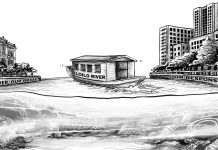



THE GREASE-like waste that coated around 300 meters of the Iloilo River near Esplanade 4 should compel Iloilo City to look beyond finding one possible polluter. It must trigger a comprehensive audit of the city’s wastewater-management system.
The contamination is raising a larger question: How many hotels, restaurants, commercial buildings and residential establishments are actually complying with requirements on grease traps, septic systems, sewage-treatment facilities and drainage connections?
It should not take a visibly polluted river to make authorities inspect facilities that ought to have been monitored regularly.
Initial findings indicated that the grease-like substance may have been discharged into the city’s drainage system following declogging operations. Residents also reported that tilapia caught in the river smelled like cooking oil. Even if the pollutant is no longer visible on the surface, its disappearance does not erase the possible damage to water quality and aquatic life.
Nor should it end the investigation.
The Iloilo River is celebrated as one of the country’s most successful river-rehabilitation stories. Once heavily polluted by untreated wastewater, fish pens and other waste, it was restored through years of government intervention and public cooperation. Its improved water quality, revived fish population and the development of the 9.29-kilometer Iloilo River Esplanade became sources of Ilonggo pride.
Yet the latest incident shows how quickly that hard-won progress can be placed at risk by a single discharge — or perhaps by a wastewater system whose weaknesses have remained hidden beneath streets and buildings.
The city government’s planned inspection of grease traps and sewage-treatment facilities near Diversion Road is necessary, but it should not stop there. Pollution follows drainage networks, not political convenience or inspection boundaries. Every establishment whose wastewater can enter public drains, creeks and rivers must be covered.
Iloilo City needs a citywide audit.
Restaurants and hotels must prove that their grease traps are not only installed but also functional and regularly cleaned. Commercial buildings and subdivisions must show that their sewage-treatment facilities are operating properly. Septic systems must be inspected for leakage, overflow and illegal discharge. Drainage connections must be mapped to determine whether wastewater pipes have been unlawfully connected to storm drains.
The city should also require establishments to present maintenance logs, desludging records, wastewater-test results and proof of proper disposal. Paper compliance must be matched with physical inspection and actual water sampling. A permit hanging on a wall cannot filter grease or treat sewage.
Unannounced inspections should form part of the program. Advance notice gives irresponsible operators time to conceal violations, temporarily clean facilities or stop illegal discharge. Environmental compliance cannot be reduced to a scheduled performance for inspectors.
The audit must also cover households and densely populated communities that still rely on poorly maintained septic tanks. Wastewater mismanagement is not exclusively a commercial problem. Leaking septic systems and direct connections to drainage canals can collectively contaminate groundwater and waterways, threaten public health and worsen foul odors during flooding.
City Hall must therefore establish a complete wastewater and drainage map identifying treatment facilities, septic systems, discharge points and connections leading to the Iloilo River and its tributaries. Without such information, authorities are essentially protecting the river while blindfolded.
The findings should be made public. Ilonggos deserve to know how many establishments were inspected, how many failed, what violations were discovered and what penalties were imposed. Those responsible for illegal discharges must shoulder cleanup and rehabilitation costs. Repeat offenders should face permit suspension or closure.
The city must also examine its own regulatory performance. Which office monitors these facilities? How frequently are inspections conducted? Does it have enough environmental inspectors, engineers, laboratory capability and enforcement personnel? If monitoring has been irregular or largely dependent on complaints, that institutional weakness must be corrected.
Iloilo City has grown rapidly, but its wastewater infrastructure and regulatory capacity must grow with it. More hotels, restaurants, condominiums, malls and commercial establishments mean more sewage, grease and wastewater. Urban expansion without adequate treatment and enforcement merely transfers the cost of development to the environment.
Iloilo City cannot claim sustainable progress while wastewater quietly travels through its drains and into its most celebrated waterway. The Iloilo River has already been rescued once. Citywide vigilance is necessary to ensure it will never need rescuing again.