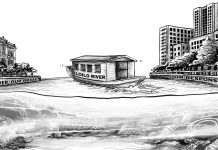




DESPITE years of drainage projects, flood-control programs, and promises of resilience, why are nearly half of Iloilo City’s population still living one prolonged downpour away from disruption, displacement, and danger?
The revelation that 72 of the city’s 180 barangays are classified as high-risk for flooding should disturb every Ilonggo. Those villages are home to more than 263,000 people. Flooding has become so routine that many have begun treating it as an unavoidable part of life. It should not be.
Every rainy season follows a familiar script. Streets become rivers. Homes are submerged. Businesses suspend operations. Classes are canceled. Families scramble to salvage their belongings. Traffic grinds to a halt. Government agencies mobilize emergency responders. Then, when the floodwaters recede, life returns to normal — until the next storm arrives and the cycle begins anew.
Is that resilience? No. That’s resignation.
To the credit of the Iloilo City Disaster Risk Reduction and Management Office, preparations appear to be in place. Early warnings are issued. Water levels are monitored. Preemptive evacuations are encouraged before floodwaters become life-threatening. These measures undoubtedly save lives.
But preparedness alone cannot become the government’s permanent answer. Emergency response addresses the consequences of flooding. It does not eliminate the causes.
Which flood-control projects have genuinely reduced flooding, and which have failed to deliver their intended results? Are drainage systems being maintained regularly? How regular is regular? Have waterways been obstructed by illegal structures, siltation, or indiscriminate waste disposal? Are new developments being allowed in areas that naturally absorb rainwater?
Climate change has fundamentally altered the equation. Extreme rainfall events are becoming more frequent and more intense. Infrastructure designed decades ago may no longer be capable of handling today’s rainfall volumes. Simply expanding drainage systems every few years is unlikely to keep pace with the growing threat.
What Iloilo City needs is a comprehensive flood management strategy that extends far beyond bigger canals and deeper drainage. It requires stricter land-use planning, aggressive clearing and rehabilitation of waterways, protection of natural catchment areas, improved pumping systems where necessary, and continuous investment in climate-adaptive infrastructure. Flood mitigation must become a central component of urban planning rather than an emergency response every monsoon season.
Residents also have responsibilities. Clogged drainage systems are often worsened by indiscriminate garbage disposal. Illegal encroachments on creeks and waterways reduce their capacity to carry floodwaters. Community discipline remains an indispensable partner to government action.
Still, the greater burden belongs to those entrusted with planning the city’s future.
No city can prevent rain. But every city can decide whether heavy rainfall becomes a temporary inconvenience or a recurring disaster.
Iloilo has earned national recognition for its urban renewal, river rehabilitation, and economic growth. It should now aspire to become equally known for protecting its people from one of the oldest problems confronting the city. Flooding should not be accepted as an annual tradition. It should become an increasingly rare exception. That is the standard Ilonggos deserve, and it is the challenge city leaders must meet.