


MANILA — President Ferdinand Marcos Jr. on Wednesday renewed his push for Congress to amend the Electric Power Industry Reform Act (EPIRA), calling for sweeping reforms aimed at lowering electricity costs, removing system loss charges from consumers and strengthening energy sector regulation to ensure long-term energy security.
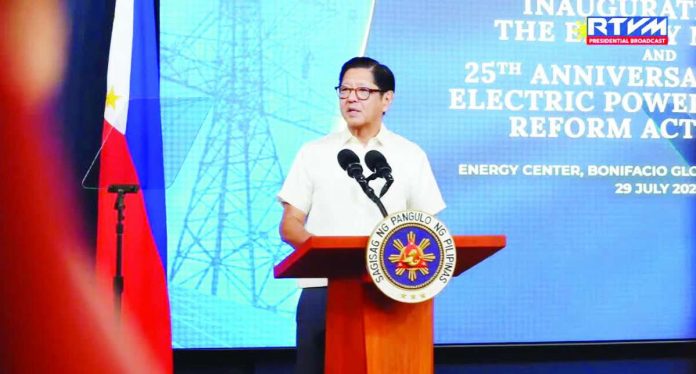
The President reiterated his appeal as he led the inauguration of the country’s first interactive Energy Museum at the Department of Energy (DOE) Center in Bonifacio Global City, Taguig, during the celebration of the 25th anniversary of EPIRA.
Marcos said while the landmark 2001 law had transformed the country’s power industry by encouraging private investment and expanding electricity generation, more reforms are needed to make electricity more affordable for Filipino households.
“Today, the results are evident. Our generation capacity has more than doubled, private investment has strengthened our power supply, and the competitive market established has helped create the conditions that support the growth of renewable energy,” Marcos said.
The President recalled that before EPIRA was enacted, the country grappled with recurring power shortages, a financially troubled state-owned electricity sector and limited market competition.
He said the law opened the industry to private investment, established the Wholesale Electricity Spot Market (WESM) and created the Energy Regulatory Commission (ERC), helping modernize the country’s power sector.
Despite these gains, Marcos acknowledged that high electricity prices remain a persistent burden on consumers.
He renewed the proposal he first made during his fifth State of the Nation Address, urging lawmakers to amend EPIRA by removing system loss charges and the corresponding value-added tax imposed on electricity consumers.
“It is only fair that Filipino families pay for what electricity they use — not for inefficiencies that really are beyond their control,” he said.
Marcos also called for amendments that would further strengthen the Energy Regulatory Commission, saying a more effective regulator is necessary to improve oversight of the power industry and protect consumers.
The President noted that renewable energy now accounts for about one-fourth of the country’s electricity supply, with the government targeting an increase to 35 percent by 2030 and 50 percent by 2040.
He likewise highlighted the administration’s energy conservation initiatives, including an order directing government agencies to reduce electricity and fuel consumption by 10 to 20 percent following tensions in the Middle East earlier this year.
“To ensure the country’s overall energy security, we have intensified our energy efficiency and conservation measures. Here in government, we hope to lead by example in energy conservation,” Marcos said.
He also encouraged the public to support the DOE’s Oras Natin sa Efficiency campaign by switching off unnecessary lights, unplugging unused appliances and adopting energy-saving practices at home and in the workplace.
Marcos said achieving an affordable, reliable and sustainable energy supply will require close cooperation among the government, private sector and the public, urging all stakeholders to support reforms that would strengthen the country’s long-term energy security./PN