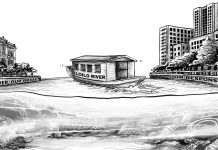



CLIMATE change is undeniably making Iloilo City’s flooding problem worse. But it must never become a convenient alibi for clogged waterways, inadequate drainage maintenance, reckless development, weak enforcement and years of poor urban planning.
The city government is correct in pointing out that rainfall patterns have drastically changed. The city used to experience less than 50 millimeters of rainfall, but it can now receive as much as 200 millimeters in only one hour. A drainage system designed using old rainfall data will naturally struggle against such an extreme volume of water.
Yet climate change does not explain everything.
It does not throw garbage into canals. It does not allow buildings, subdivisions and concrete structures to rise without adequate stormwater facilities. It does not neglect waterways until they are choked with silt, weeds and waste. Neither does it approve flood-control projects that fail to deliver the protection promised to the public.
When every flooded street is blamed principally on climate change, government risks turning a complex failure of planning and management into an unavoidable act of nature. That framing is dangerous because it weakens accountability. If the rain alone is blamed, nobody has to answer for undersized culverts, obstructed drainage lines, poorly maintained canals or developments that send runoff into already vulnerable communities.
Iloilo City has completed nearly 421 declogging operations since last year. That figure shows that the city government recognizes the importance of keeping drainage facilities clear. It also raises a fundamental question: Why are so many declogging operations necessary, and why do some areas repeatedly flood despite them?
The city must determine whether the problem is recurring garbage accumulation, inadequate drainage capacity, disconnected lines, improper elevation, restricted outfalls or a combination of these. Declogging should not become an endless cycle in which workers clear the same canals after every downpour while the underlying causes remain untouched.
Residents have responsibilities, too. People who discard plastic, household waste and other debris into canals contribute directly to flooding. Barangays must enforce waste-disposal rules consistently, while the city should identify and penalize habitual violators. Climate resilience begins not only with expensive infrastructure but also with basic civic discipline.
Poor urban planning is an equally serious concern. As Iloilo City expands, open spaces and absorbent ground are steadily replaced by roads, parking areas, subdivisions, commercial buildings and other concrete developments. Rainwater that once soaked into the soil is forced into drainage systems that may already be operating beyond capacity.
Developers must therefore be required to manage the additional runoff generated by their projects. Major developments should have properly designed retention facilities, permeable surfaces and drainage connections that do not simply transfer floodwater to neighboring communities. Permits must not be issued on paper compliance alone. Actual construction must be inspected, and violations must carry meaningful penalties.
Existing infrastructure also requires honest assessment. Some drainage lines may have become too small for current conditions. Others may be damaged, poorly connected or blocked by utilities and private structures. Pumping stations, river outlets and flood-control facilities must be regularly inspected and maintained before the rainy season—not only after residents are already wading through dirty water.
The proposed Comprehensive Drainage Masterplan is therefore urgently needed. It should map the movement of water across the city, identify bottlenecks, evaluate existing infrastructure and establish clear priorities for upgrading the system. But the masterplan must examine more than rainfall projections. It must investigate how land conversion, construction practices, solid-waste failures, neglected waterways and fragmented government projects contribute to flooding.
Climate change is real, and Iloilo City must prepare for heavier and more unpredictable rainfall. But adaptation begins with acknowledging every cause of the problem — not choosing the explanation most convenient to officials. The rain may be stronger than before, but floods become disasters when government planning is weak, infrastructure is neglected, rules are ignored and waterways are abused.
Climate change may explain why the skies are releasing more water. It cannot excuse why Iloilo City remains unprepared to receive it.