
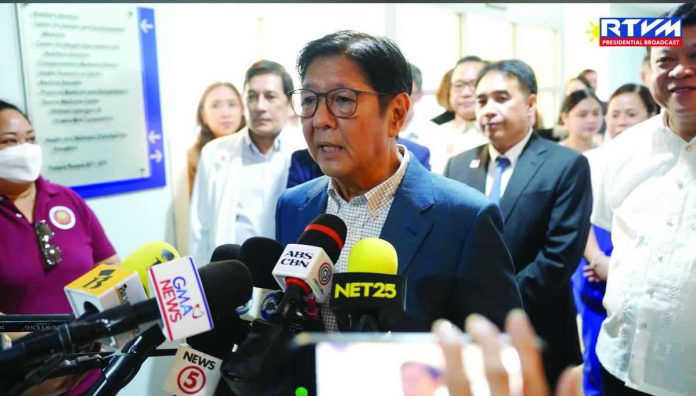
MANILA — President Ferdinand “Bongbong” Marcos Jr. on Tuesday urged more private hospitals to adopt state-owned Philippine Health Insurance Corp.’s (PhilHealth) no-co-payment policy, seeking to extend protection from costly out-of-pocket medical expenses beyond government health facilities and give more Filipino patients access to private hospital care without being burdened by additional charges.
Marcos issued the call after witnessing the signing of an agreement between St. Luke’s Medical Center–Global City and PhilHealth in Taguig City, a partnership the administration hopes other private healthcare institutions will follow.
Under the agreement, eligible PhilHealth members admitted to basic or ward accommodations at St. Luke’s Global City may receive covered medical services without additional co-payments, subject to PhilHealth rules and requirements.
“Together, let us ensure that no Filipino is denied the care that they need only because of financial hardship,” the President said.
Marcos said the cost of hospitalization remains a major concern for Filipino households, with families often forced to worry about medical bills while dealing with the illness of a loved one.
“Getting sick is difficult enough. But for many families, the bigger worry is how to afford the treatment that they need,” Marcos said.
He stressed that seeking treatment at a private hospital does not necessarily mean a patient can comfortably afford the cost. Some patients, he said, turn to private facilities because their medical conditions require specialized services, equipment or expertise that may not be readily available elsewhere.
The St. Luke’s-PhilHealth partnership strengthens the implementation of PhilHealth benefit packages, particularly the no-co-payment policy for qualified members occupying basic or ward accommodations.
Marcos said expanding such arrangements in the private sector would complement the government’s broader campaign to reduce the amount patients have to pay directly for healthcare.
Among these measures is the Zero Balance Billing program in Department of Health hospitals, which seeks to eliminate remaining hospital charges for qualified patients.
The administration is also expanding electronic access to the Medical Assistance to Indigent and Financially Incapacitated Patients program while simplifying documentary requirements and facilitating online applications.
PhilHealth’s Yaman ng Kalusugan, or YAKAP, program is likewise being expanded to provide members with free consultations, laboratory services and cancer screening, while medicines for eligible patients are being made available through the Guaranteed and Accessible Medications for Outpatient Treatment program.
The government has also established Bagong Urgent Care and Ambulatory Service Centers to bring urgent and outpatient medical services closer to communities.
Marcos said healthcare reforms must not only lower medical expenses but also simplify government procedures that patients and their families must navigate while seeking assistance.
“Ang sistema dapat ang tumutulong sa pasyente. Hindi dapat sila mahirapang sumunod sa mga prosesong lalo lamang nagpapabigat sa kanilang buhay,” Marcos said./PN