

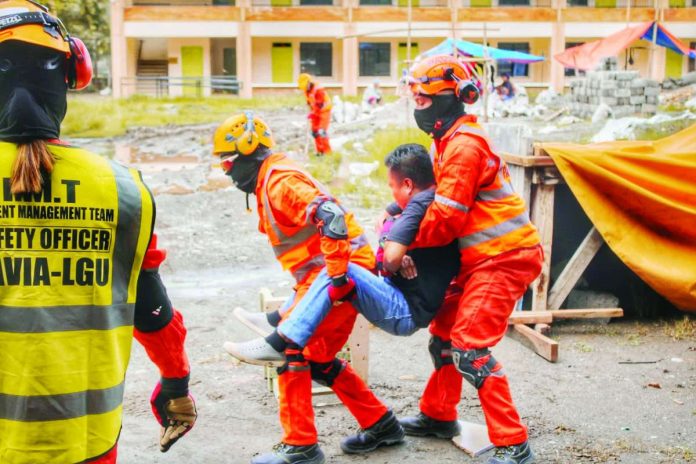
ILOILO — To bolster local disaster response, the Municipality of Pavia executed a high-intensity Collapsed Structure Search and Rescue (CSSR) Simulation Exercise on September 10 at Pavia National High School (new site).
This was the centerpiece of the municipality’s participation in the 3rd Quarter Nationwide Simultaneous Earthquake Drill (NSED).
Designed to test the speed, coordination, and technical precision of local emergency responders, the simulation transformed sections of the school campus into a controlled, realistic post-earthquake emergency site.
Realistic Simulation Scenarios
The exercise tested responders under simulated structural collapse conditions to mirror the immediate fallout of a major seismic event such as:
* Victim Location & Detection – Rescue teams deployed technical search protocols and specialized detection tools to pinpoint simulated survivors trapped under debris.
* Breaching & Wall-Cutting – Trained responders executed precise structural breaching through reinforced masonry, concrete barriers, and timber obstructions to reach confined spaces safely.
* Extrication & Patient Stabilization – Field teams performed technical extrications, safely removing trapped individuals while administering immediate emergency triage and stabilization.
* Inter-Agency Command System – The drill stress-tested the Incident Command System (ICS), coordinating local emergency services, medical responders, and school administrators in real time.
Disaster management officials emphasized that high-impact simulations like the CSSR exercise are essential to moving beyond simple “Duck, Cover, and Hold” protocols.
Highlighting the constant threat posed by the nearby West Panay Fault, the Pavia Municipal Disaster Risk Reduction and Management Office (MDRRMO) emphasized that multi-agency coordination and regular disaster simulations are vital to protecting lives during major earthquakes.
Pavia MDRRMO Head Rommel A. Jamerlan noted that no one is immune to seismic hazards given the town’s geographic proximity to the active fault line.
He expressed gratitude to the Office of Civil Defense (OCD) and emergency response units for their ongoing support in keeping the community disaster-ready.
Jamerlan stressed that effective disaster management cannot be shouldered by a single local government unit alone, calling for a unified, “whole-of-agency” approach to emergency response.
Addressing the purpose of continuous drills and simulation exercises, Jamerlan underscored that regular practice allows response teams to evaluate their capabilities and fix operational gaps before a real crisis hits./PN