


ILOILO City – Artificial intelligence (AI) has penetrated Philippine workplaces at a rapid pace, with 75 percent of Filipino workers already using the technology and 54 percent of students accessing it at least weekly, according to the Department of Economy, Planning, and Development (DepDev).
Government economic planners are thus pushing for responsible adoption rather than outright prohibition.
Data presented by DepDev showed that 46 percent began using AI in the past six months, while adoption among Filipino knowledge workers has reached 86 percent.
Despite the rapid uptake, however, AI utilization remains largely basic, with the country facing challenges in transitioning toward more advanced and specialized applications.
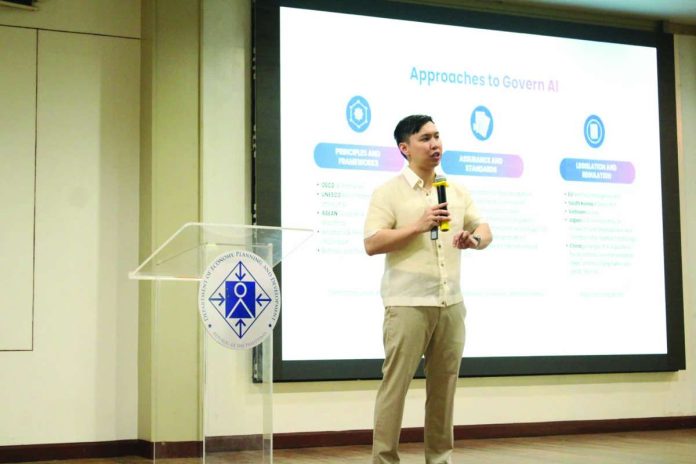
“The same data has also shown that this use remains basic, with all due respect—such as ChatGPT,” said Atty. Diego Luis S. Santiago, assistant director of the DepDev Innovation Staff, during the agency’s innovation roadshow in Iloilo City.
Santiago attributed the rapid adoption to Filipinos’ deep immersion in digital platforms, facilitated even by free mobile data services.
“The Philippines is known for social media capitalism. We are one of those countries where access to social media and digital sites is apparent even without regular internet,” Santiago said.
“Kahit walang internet, meron na tayong mga plans to access social media, where we coordinate, immerse ourselves in the digital space, and get most of our information,” he added.
In the education sector, the widespread use of AI among students is forcing academic institutions to rethink traditional teaching methods.
“Our students are already adopting AI in households and schools, to the point that our educators are not able to keep up,” Santiago said.
Rather than banning AI, some educational institutions are integrating the technology into classroom activities to develop students’ critical thinking skills.
“One school shared that for their book report assignment, students no longer just draft a report. The assignment now is to draft a book report using AI, and then criticize the AI-generated report in the classroom,” he said.
“We’ve seen how the education sector is pivoting—not toward simply having AI, but utilizing it as a tool,” he added.
With the Philippine AI market projected to reach $3.49 billion by 2030, Santiago warned that excessive regulation could undermine innovation and economic growth.
“It will not be practical to strictly ban artificial intelligence when usage is already organic,” he said.
“People should not suppress the opportunity to innovate and create stronger economic development within our country. Instead, we need to properly communicate and recognize the possible risks and harms of AI so people use it in a more responsible and ethical manner,” he added.
DepDev, however, identified several risks associated with AI, including discrimination, misinformation, scams, system failures, and data privacy and security breaches.
Santiago particularly cautioned against unguided AI use among young people, citing instances raised during public consultations in which bullied students turn to search engines or AI chatbots for advice instead of trusted adults, potentially exposing themselves to harmful or discriminatory content.
“AI works based on the information included in it,” Santiago said.
“If the information there brings toxicity and discrimination, the main problem is that the answers will reflect that too,” he added./PN