



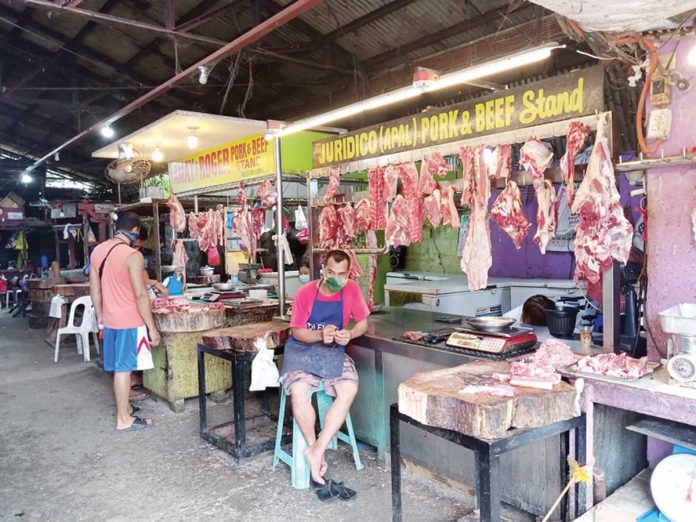
ILOILO City – Western Visayan consumers are seeing an increase in the price of pork. But the Department of Agriculture (DA) believes this won’t take long. It hopes the recently approved cut in pork import tariffs would boost the supply.
Pork prices in the region now hover around P255 per kilo on average compared to last month’s P245.
Regional Director Remelyn Recoter confirmed to Panay News “may pagtaas gid man especially sa Antique.” Prices of pork in Sibalom town there rose up to P270 per kilo.

In the first two months of 2021, pork prices in the region remained almost constant, but an increase was felt beginning March.
What pushed pork prices up?
“Nagsaka ang pork price kay nagsaka man ang baklanay sang live hogs,” Recoter told Panay News.
The director noted that in the first two months this year, live hogs were sold at P130 to P140 per kilo. From March until now, the price ranges around P150 to P170.
This was in relation to the dearth in pork supply in the National Capital Region (NCR) due to the African swine fever (ASF). Western Visayas supplies pork to the NCR.
Purchasers from Metro Manila were buying live hogs at P150 to P170 per kilo “so kon ikaw tag-iya, didto mo ibaligya sa taas ang bakal,” Recoter explained.
This situation actually benefits hog raisers, she pointed out. Consumers, meanwhile, may experience the “slight” increase just for now.
DA-6 records showed that as of third week of March, about 70,000 heads of live hogs have been delivered to Metro Manila from the region.
Western Visayas has maintained its ASF-free status.
HOPES ON EO 128
The DA-6 is banking on President Rodrigo Duterte’s recent approval of Executive Order (EO) 128.
What does it provides?
EO 128 reduces tariff rates for both in-quota and out-quota imports of pork.
Tariff rates for imported pork within the minimum access volume will be down to five percent for the first three months upon the EO’s effectivity and 10 percent for the fourth to 12th month from the current rate of 30 percent.
“With this, we are expecting that these pork imports would boost the supply, especially in Metro Manila. So this would imply nga ma-decrease na ang live hogs nga ipadala naton didto sa ila,” Recoter stressed.
Meantime, if a consumer finds the current pork prices in the markets costly, Recoter said they may opt to shift to other sources of protein like chicken or fish.
“So, may shifting sa food preference nga matabo. Siempre kon mahal, may ara man mas barato nga other sources,” she said./PN