

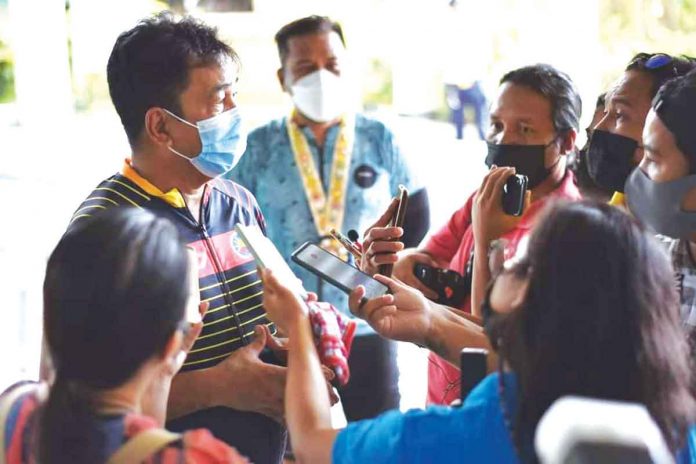
ILOILO City – Commission on Higher Education (CHED) chairperson J. Prospero De Vera III who visited school campuses here on Nov. 25 pushed for school-based vaccination against coronavirus disease 2019 (COVID-19) as part of preparations for the expansion of limited face-to-face classes.
It is easier if vaccination is done in schools as universities have bigger facilities that they can convert into vaccination sites, De Vera said.
The progress of the vaccination rollout can be easily monitored since schools have their list of enrollees and students, he added.
Currently, the nationwide vaccination rate for students is at 42 percent, and 72 percent for faculty and employees.
Inoculation of teachers and workers started in April this year while student vaccination kicked off only on Oct. 15 when the country allowed young people aged 12 to 17 years old to get the jab.
“Forty percent is already a high number given the fact that they started only on Oct. 15. Now we want it to go higher and faster,” de Vera said.
Vaccination hesitancy is not an issue in schools, De Vera added.
He was informed that West Visayas State University (WVSU) has around 60 percent vaccination rate while the Iloilo Science and Technology University (ISAT-U) was scheduled to submit its selected students to vaccination yesterday.
De Vera thanked the universities for being flexible amid the pandemic.
Together with several Ilonggo bike enthusiasts, he visited various universities and selected grantees of the Tertiary Education Subsidy (TES), through the “Padyak to claim victory for free higher education”.
“This year we are graduating the first batch of Filipino students who completed their education for free. I thought it was only proper to claim it because we have already proof of concept. We proved that we could do it and I started biking around different regions,” De Vera said.
He said 1.6 million Filipinos enrolled in 200 public universities in the country are no longer paying their miscellaneous fees. It is projected that this coming year, the enrollees will increase to 1.8 million.
The free tuition started in 2017 while the no-miscellaneous-fees policy was introduced in 2018.
Some 500,000 students are likewise recipients of the TES and 200,000 are recipients of the Tulong Dunong, a grants-in-aid scholarship program of CHED.
“All in all more than two million Filipinos are now being assisted by the government,” De Vera said. (PNA)