


SAN JOSE, Antique – In a bid to boost air travel, the Department of Transportation (DOTr) is investing P2.5 billion to upgrade three airports so that they can accommodate more flights and passengers.
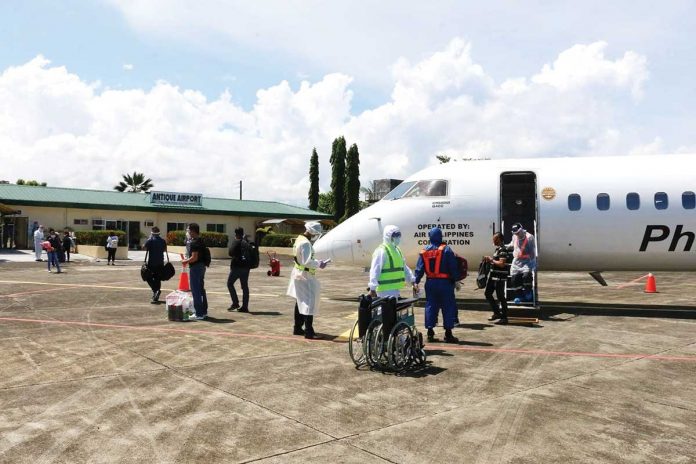
Under DOTr’s P2.5-billion Aviation Infrastructure Program in the 2023 national budget, Antique Airport, also known as Evelio Javier Airport, would get P500 million, while Laoag International Airport would receive P445 million.
Tacloban City Airport, also known as Daniel Romualdez Airport, would receive the bulk of the new funding, or P1.42 billion, according to Makati City’s Cong. Luis Campos Jr., House appropriations committee vice-chairperson.
The Civil Aviation Authority of the Philippines (CAAP) designates Antique Airport as a principal class 2 domestic airport.
Tacloban City Airport is a principal class 1 domestic airport while Laoag International Airport is a secondary/alternate international airport.
Antique Airport, also known as San Jose Airport, is the only airport in the province of Antique. It is located in the provincial capital San Jose de Buenavista.
The airport is named after Evelio Javier, a Marcos-critic politician who served as Antique’s governor from 1971 to 1980 and was assassinated on Feb. 11, 1986, just two weeks before the People Power Revolution.
It was partially renovated with the help of Sen. Loren Legarda and Antique’s Gov. Rhodora Cadiao.
The Airport Terminal Building and other Facilities is being planned for reconstruction to accommodate more passengers and planes. Prior to the renovation, the airport was not operational due to a lack of passengers travelling from Antique to Manila.
Campos said Bukidnon Airport, which is projected to commence commercial operations in 2023, would get P80 million, while the Ninoy Aquino International Airport would receive PHP43 million.
“We are all for increased spending to build up our aviation infrastructure across all regions,” Campos said in a news release on Sunday. “There’s no question that airports are powerful generators of economic growth, jobs and income.”
“They facilitate mobility of people and goods, which also benefits consumers and industries, especially micro, small and medium enterprises (MSMEs) that now account for 99 percent of the 958,000 registered business establishments in the country,” Campos said.
He said bigger and better airports are also indispensable to the country’s overall disaster readiness.
“They enable us to rapidly deploy emergency first responders as well as relief supplies and equipment to regions hit by typhoons, earthquakes, and other natural calamities,” Campos said.
The Philippines has been tagged as one of the world’s most disaster-prone countries, being at the center of a typhoon belt and within the Pacific Ring of Fire frequented by volcanic eruptions and earthquakes.
Campos said government funding for aviation infrastructure is usually spent to construct, rehabilitate, or improve runways, taxiways and aprons, air traffic control buildings as well as passenger and cargo terminals.
The money is also spent on aircraft refueling facilities, fire and rescue stations, powerhouses, water and sewage systems, and perimeter fencing, among others, Campos said./PN