


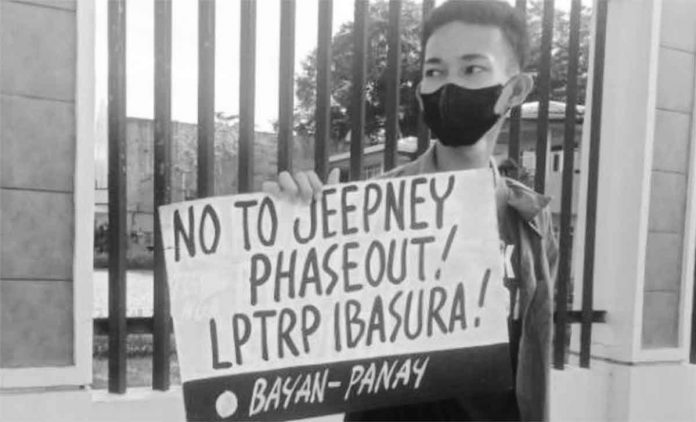
ILOILO City – An alliance of consumers here is calling for the indefinite suspension of the Local Public Transport Route Plan (LPTRP) crafted in line with the public transport modernization program of the national government.
The Panay Consumers Alliance (PCA), in a position paper to be presented for today’s Iloilo City Transport Summit, said the LPTRP is essentially a step towards the total phasing out of traditional jeepneys in the guise of modernization.
Under the Public Utility Vehicle Modernization Program (PUVMP), traditional jeepneys will no longer ply the roads and will now be considered as junks. Modern mini buses will be used instead – restructured, modern and environmentally sustainable – where drivers are given daily wages, with stable jobs and commuters will experience comfortable and free from inconvenience during travel.
“But behind this grandiose program is a money-making scheme to monopolize the transport sector where foreign manufacturers and suppliers, big banks, and transport business corporations will rake a huge amount of profit from,” according to PCA.
A single unit of the modern PUV costs around P2.5 million.
“With 6% interest rate payable for seven years, the total interest value is P1.05 million, or 42% of the original value. In order to fully pay for a single unit alone, it has to make an income of P1,389 daily for seven straight years. That is next to impossible,” according to the PCA.
The group noted that fuel expenses of a modern PUV or mini-bus is estimated around P3,000 to P3,500, while the wages of the driver and his assistant is worth P900.
“This means that a single unit of the modern PUV should at least make an income of P7,000 – P8,000 a day in order to pay for its expenses – fuel, wages of the driver and its assistant, inspector and staff of the cooperative, unit maintenance and many more,” the PCA said.
But this is again impossible according to the group.
“A unit can only cater around 25-30 passengers, with a minimum fare of P11. In order to pay for the expenses, increasing the fare is therefore inevitable,” it pointed out.
“This in turn will become a burden for the commuters. But those transport business groups and capitalists, and the bank have already earned tremendous profit while the public has to suffer inexorably,” according to the group.
‘BURDEN’
The implementation of the LPTRP under the PUVMP has been proven a burden to the riding public, and the drivers and operators, they added. They listed th e following observations:
* shortened routes of provincial bound jeepneys from Oton, San Miguel, Leganes, Sta. Barbara and Pavia; this means lower income for our jeepney drivers.
* because of the new routes, tricycle drivers’ income is also affected because of lesser number passengers
* only 1,767 modern PUVs will be plying the roads in exchange of 2,538 traditional jeepneys; this means that 771 jeepneys or an equivalent of 1,542 drivers (one jeepney is being driven by two drivers interchangeably in a week) will lose their livelihood if the PUVMP and LPTRP are implemented.
* for the commuters, the new routes under the LPTRP are longer, therefore they will expend more in fare and are inconvenienced by its longer travel time, especially to our workers who are earning a meager wage
* for those traveling from towns, they are incurring an average of P5 – P7 increase in their fare; the additional P2 increase by the LTFRB is another burden for them. This is burdensome for our students and their parents. The promised “easier and faster” commute experience is nil.
* for vendors, they can no longer bring their produce directly to the city markets; this will also incur them additional fare expenses. The increase in their fare will reflect also in the increase of their products’ prices which will affect the consumers as well.
“The suspension of LPTRP of 45 days, which was extended for another 45 days, is an indication that it did not pass through a rigorous process including public consultation.”
The group further demanded the following:
* indefinite suspension of the LPTRP and end to the current modernization program of the government
* nationalization of the transport system, by developing our transport manufacturing and improving the road network, to maintain its public character
* review and improving of the existing local public transport route plan together with rigorous and massive information campaign with the riding public and the drivers
* support for local transportation manufacturers for the rehabilitation of traditional jeepneys
* livelihood subsidy in the form of aid for our drivers affected the oil price increases
* fare subsidy to benefit our commuters affected by the inflation
* genuine land reform and national industrialization/PN