


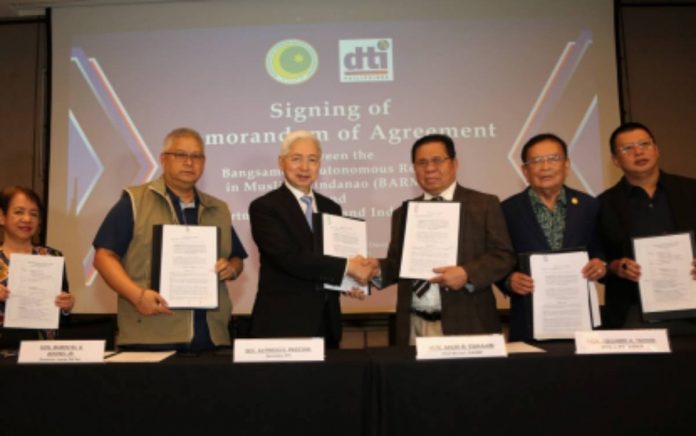
THE Department of Trade and Industry (DTI) said the Philippines will be launching a national Halal strategy which aims to generate P230 billion in investments, create 120,000 jobs in five years, and support micro, small and medium enterprises (MSMEs) in becoming part of a global halal ecosystem before the end of this year.
The Halal strategic planning follows President Ferdinand R. Marcos Jr.’s message to international investors at the World Economic Forum in Davos, Switzerland positioning the Philippines as a gateway to the Asia-Pacific region.
The plan will also address the growing demand for Halal products and services from both the Philippines’ domestic market and from the 57 countries that are members of the Organization of Islamic Cooperation (OIC) – spanning Asia, the Middle East, Africa, Europe and the Americas.
“Halal as a way of life is not only for the Muslims. It is increasingly being recognized by many non-Muslim consumers worldwide because of ethical considerations, hygiene, fair trade, and just financing,” DTI Secretary Alfredo Pascual said.
“Over the next five years, we plan to achieve P230 billion Halal trade and investments and generate 120,000 jobs,” he added. “By maximizing our potential in the Halal industry, together we will help realize the vision of President Marcos Jr. in gaining more investments, which will mean higher economic activity and more quality jobs, and then a better life for all Filipinos.”
Considering the growing Muslim population of at least 1.9 billion people, the global Halal market is estimated to reach USD7.7 trillion in market value by 2025, up from USD3.2 trillion in 2015.
The DTI will be leading the nine-government inter-agency taskforce that will create a roadmap which will position the Philippines as the most Halal-friendly trade and investment hub in Asia Pacific.
Pascual highlighted that the Halal industry forms part of DTI’s four priorities: promoting regional development; attaining food security; upgrading, upskilling, and upsizing MSMEs; and enabling job skills matching and skills upgrading.
The Halal plan is not only confined to food and food-related products but also includes Islamic finance, Halal-friendly travel and tourism, modest fashion, Halal pharmaceuticals and Halal cosmetics sectors.
To cover the wide-ranging aspects of Halal economy, the Halal Taskforce will include the National Commission on Muslim Filipinos (NCMF), Department of Agriculture (DA), Bangko Sentral ng Pilipinas (BSP), Department of Tourism (DOT), Department of Health (DOH), Department of Science and Technology (DOST), Department of Foreign Affairs (DFA) and Mindanao Development Authority (MinDA).
MSMEs are set to benefit from the DTI‘s Halal initiatives.
Additionally, the Philippines is set to sign another landmark agreement with the United Arab Emirates. (PNA)/PN