




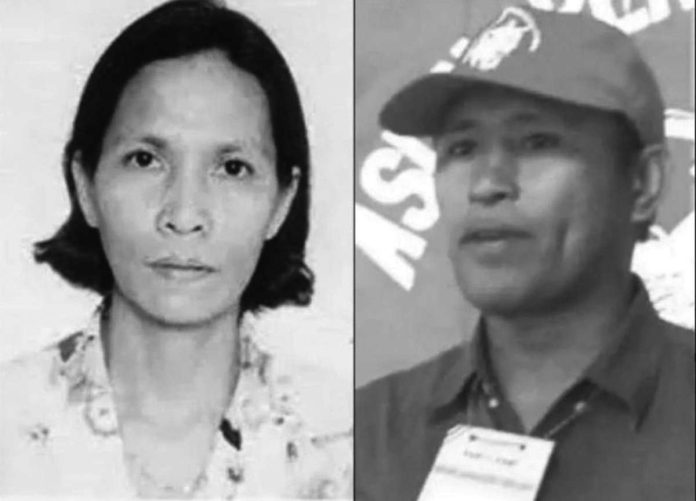
ILOILO City – Eighteen years ago, on the evening of April 12, Iloilo activists Maria Luisa “Luing” Posa-Dominado and Nilo Arado were abducted by armed men in Barangay Cabanbanan, Oton, Iloilo.
Their companion, human rights worker Jose Ely Garachico, was shot in the neck and left for dead but survived to recount the incident. He described how their vehicle was stopped by heavily armed men, who took Luing and Nilo at gunpoint and forced them into other vehicles.
The victims’ vehicle was commandeered, driven to a different town, and set on fire. Luing and Nilo were never seen or heard from again.
Posa-Dominado was a long-time activist and a political prisoner during martial law. She served as the spokesperson of Samahan ng mga Ex-Detainees Laban sa Detensyon at Aresto (SELDA). Arado was a land rights advocate, a national council member of Kilusang Magbubukid ng Pilipinas (KMP), and the chairperson of Paghugpong sang mga Mangunguma sa Panay kag Guimaras (PAMANGGAS), organizations pushing for agrarian reform in the country.
Before their abduction, both victims were actively campaigning for the progressive party-list groups Bayan Muna and Anakpawis.
Their abductions occurred in the same month that peasant activist Jonas Burgos was kidnapped from inside a mall in Quezon City, and less than a year after youth activists Sherlyn Cadapan and Karen Empeño were abducted by soldiers in Bulacan in June 2006. These incidents are among the 2,135 enforced disappearances documented by human rights monitor KARAPATAN under the previous five administrations and the first two years of President Ferdinand Marcos Jr.’s administration.
Angelo Karlo T. Guillen, a lawyer from the National Union of Peoples’ Lawyers – Panay (NUPL), criticized the government’s handling of these cases, arguing that they reveal the state’s complicity in these human rights violations.
Guillen stated, “The Philippines has failed to address the rampant cases of enforced disappearances, which involve the direct or indirect involvement of state agents. These cases persist because of the government’s refusal to acknowledge its role and its reluctance to hold perpetrators accountable.”
Guillen also pointed to the International Convention for the Protection of All Persons from Enforced Disappearance (ICPPED), which defines enforced disappearance as the abduction or detention of a person by state agents or groups acting with state support. Despite being a signatory to the treaty, the Philippine government has yet to ratify the ICPPED, thereby closing avenues for truth-seeking and accountability.
He emphasized that enforced disappearances, like the cases of Luing and Nilo, are part of a systematic practice used by authoritarian regimes to eliminate dissent.
“These crimes are a tool of control,” he said, highlighting that enforced disappearances, alongside extrajudicial killings, are designed to instill fear and neutralize political opposition.
Guillen urged the government to stop denying its involvement and instead take meaningful steps to investigate and prosecute those responsible for these heinous acts.
“The legal framework, including the Rule on Amparo and the Anti-Enforced or Involuntary Disappearance Act, is inadequate without a genuine recognition of the state’s role in these crimes,” he said.
Until that happens, he warned, the victims of enforced disappearances, like Luing and Nilo, will continue to be the faces of the state’s failure to deliver justice./PN