



ILOILO – The provincial government of Iloilo has raised its earthquake readiness to heightened alert after a magnitude 4.4 tremor jolted Guimbal town on Wednesday morning — the strongest quake to hit the province in recent weeks — triggering building inspections, class suspensions, and a temporary halt in government operations.
The quake, recorded at 6:48 a.m. on Oct. 15, was the most intense since the September 30 earthquake, according to the Iloilo Provincial Disaster Risk Reduction and Management Office (PDRRMO). It registered Intensity IV on the seismic scale and was felt across the province.
An earthquake is a sudden shaking of the ground caused by the movement of the Earth’s crust along faults or fractures. In the Philippines, the intensity scale is used to describe the severity of shaking experienced by people and structures in a given area — with Intensity I being barely perceptible, and Intensity X causing total devastation.
The Philippine Institute of Volcanology and Seismology (Phivolcs) located the epicenter about 13 kilometers south-southwest of Guimbal at a depth of 10 kilometers.
Instrumental intensities were also noted in nearby areas — Intensity III in Nueva Valencia, Guimaras, and Intensity II in San Lorenzo, Guimaras; Bago City, Negros Occidental; and light tremors in Culasi, Antique, and La Carlota City.
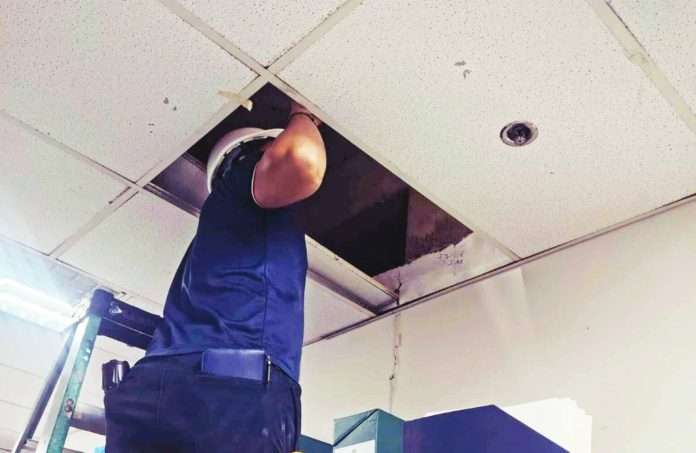
PDRRMO’s Fonz Baldonado said provincial engineers were immediately tasked to verify possible structural damage across affected municipalities.
“As of now, our Engineering Office is continuing to assess the cracks in our structures. The initial observations indicate that existing cracks have extended since the earthquake began in Bogo City, Cebu. This is currently the highest reading on our intensity meter,” he stated.
He appealed to residents to keep a safe distance from old or damaged structures.
“We request the cooperation of everyone to move away from structures that are under observation. It is vital to maintain a safe distance from tall buildings during this time,” Baldonado added.
Gov. Arthur Defensor Jr. immediately convened the Civil Defense Cluster following the tremor to assess its impact on public safety and infrastructure.
Operations at the Iloilo Provincial Capitol were suspended as engineers evaluated the building’s stability.
“Ang protocol naton na sang una, nga after we execute, after we inspect the building, nagabalik kita after one hour. Pero, we will adjust sa subong. Lain ang panahon… Ginalinog kita. Ang epicenter naton subong, ari sa probinsiya. So, lainon ta anay ang aton nga response… Let us observe that. Indi anay kita magsulod sa opisina..may sixth floor kita. We come back tomorrow,” Defensor said.
He also met with Department of Public Works and Highways (DPWH) officials to discuss results of the Hammer Rebound Test conducted on all floors of the Capitol, ensuring the building’s structural integrity amid the heightened seismic activity.
Meanwhile, the Department of Education (DepEd) suspended face-to-face classes from Kindergarten to Senior High School in the first congressional district, and all levels in Pavia town, as part of precautionary measures.
Dr. Ernesto Servillon Jr., Schools Division Superintendent, cited possible structural risks in school buildings pending inspection.
The Iloilo City Government, through DepEd Order No. 022, series of 2024, also authorized school heads to decide on class suspensions after safety evaluations.
Information Officer Hernani Escullar Jr. clarified that mandatory suspensions apply only for quakes of Intensity VI or higher, but schools must still conduct thorough inspections with DPWH or local officials before resuming classes.
The earthquake follows two major tremors earlier felt in Western Visayas — a magnitude 6.9 in Bogo City, Cebu on Sept. 30 and a magnitude 7.4 offshore Manay, Davao Oriental on Oct. 10.
The Office of Civil Defense (OCD) has since ordered urgent inspections of schools, hospitals, bridges, and other public structures to ensure safety.
Phivolcs said the recent earthquakes are unrelated but serve as reminders of the region’s exposure to active fault systems.
The Philippine Seismic Network operates 121 monitoring stations nationwide, including three manned stations in Western Visayas, to improve earthquake tracking and preparedness./PN