



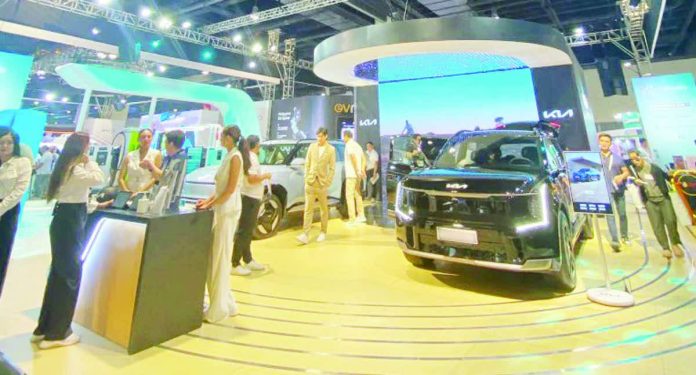
THE TARGET of having at least 2.5 million electronic vehicles (EVs) on Philippine roads by 2040 seems achievable as more innovative units are being introduced, and the government remains committed to boosting the sector, an industry official said on Thursday, October 23.
Citing end-July 2025 data of the Land Transportation Office, Edmund Araga, president of the Electric Vehicle Association of the Philippines, in his speech during the opening ceremony of the Electric Vehicle Summit at the SMX Convention Center in Pasay City, said EV registration rose to 29,715 units, higher than the 24,000 registered for the entire 2024.
He said the latest available number represents about 5 percent of new vehicle registrations, which is thrice the figure two years ago, and will likely push the end-2025 figure to 35,000 units.
“The bold target is to make EVs account for at least 50 percent of all vehicles on our roads by the year 2040. Our sector is hoping that the attractive incentives and perks offered to our motorists to shift to electric will further go full swing,” he said.
The government has supported the use of EVs through the Electric Vehicle Industry Development Act, or EVIDA Law.
Among others, the EVIDA Law exempts EVs from the Unified Vehicular Volume Reduction Program for eight years upon the law’s implementation, and tax breaks and temporary zero-tariff are given to manufacturers for a certain period to encourage investors.
Araga noted that in China, the shift to EVs “is not powered by aggressive pricing but by impressive features.”
“Cars are judged like smartphones now. Thus, technology has three to six times influence than price. It was manifested in China, and logically, it will also reflect on our local market,” he said.
Araga, in turn, also noted the increase in the number of EV charging stations (EVCS) in the country, particularly in the National Capital Region.
He said EV stakeholders have set a target to deploy an estimated 7,300 EVCS nationwide by 2028 and 20,400 by 2040.
“This is our challenge. We continue to persuade and encourage the public and private sectors to work double time to speed up the growth of EVCS in the Philippines. It is just logical that as the number of EVs consistently jump every year, the figure for EVCS must match that spike so as to convince more Filipinos to switch to EV and realize the economic and environmental benefits of turning to electric mobility,” he added.
Special Assistant to the President for Investments and Economic Affairs Frederick Go, during the event, said the government is committed to further bolstering the EV industry growth, noting the strong growth of EV sales because the units are “beautiful, (they) save on fuel, need little maintenance, and (are) quiet.”
He said they are currently in talks with an EV manufacturing firm that is “very serious about building electric vehicles in the Philippines.” He, however, declined to elaborate.
Total car sales
Amid the growth in several types of vehicles, overall growth in the first nine months this year declined by 0.3 percent on an annual basis, after total sales reached 343,410 units from last year’s 344,307.
In the previous month, motor vehicle sales rose 0.2 percent to 305,381 units.
As of September, heavy-duty trucks posted the biggest growth at 50.6 percent, followed by light commercial vehicles, 9.7 percent; light duty trucks and buses, 9.6 percent; commercial vehicles, 8.2 percent; and Asian utility vehicles and multi-purpose vehicles, 3.7 percent.
On the other hand, sales of passenger cars declined by 23.6 percent, and medium-duty trucks and buses, by 11 percent.
In terms of EVs, total sales reached 20,662 units, led by hybrid electric vehicles, 16,335; battery electric vehicles, 3,657; and plug-in hybrid electric vehicles, 670. (PNA)