


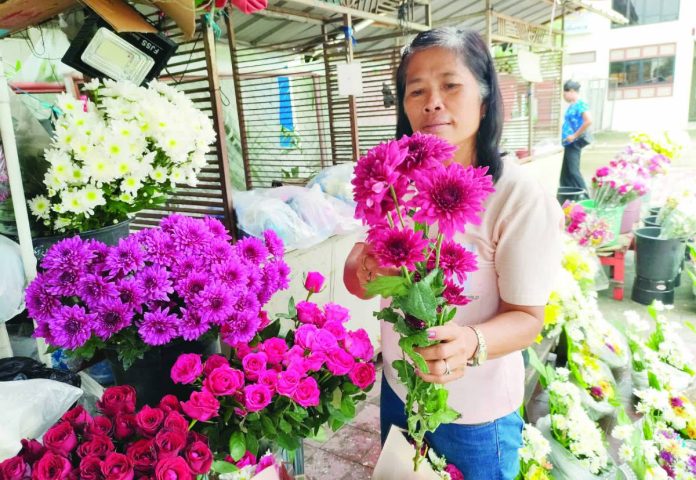
ILOILO City – Beneath the shadow of the grand Jaro Metropolitan Cathedral, the air is thick with the fragrance of roses, chrysanthemums, and orchids. Amid this colorful chaos stand the flower vendors of Jaro — mostly women — whose hands, weathered by years of work, have woven stories of love, loss, and quiet triumph.
For decades, these vendors have been the silent witnesses to Iloilo’s most intimate moments: funerals, wakes, weddings, graduations, birthday, and Valentine’s Day. They are there, rain or shine, arranging blossoms into symbols of affection, faith, and remembrance.
Grace in Bloom
One of them is Mary Grace Quintar, 55, from Barangay Ungka, Pavia, Iloilo. For more than three decades, she has been a fixture outside the cathedral, her stall a familiar sight to churchgoers and visitors.
“Dalaga pa ko daan, gaintra kag gabaligya na ako sang bulak,” she recalls with a nostalgic smile. “Mga high school, gabaligya na ako ka bulak, te sang may panagbuhi na, nag padayon man ko gyapon sa pamaligya.”
She started selling garlands and small bouquets while still in school, continuing the family trade after her mother, once a vendor herself, grew too old to work.
For Grace, flower vending isn’t merely an income source — it’s a legacy.
“Nag umpisa kami sa plaza, kada okasyon, kada Valentines o pista minatay,” she shares. “Naandan na ni namon nga kada tuig mabaligya.”
From modest beginnings in the plaza to a permanent stall in Jaro, her blossoms have seen countless faces and stories. Her flowers have become tokens of devotion and endurance, much like her own life.
Dolores and the Dream of Dignity
A few stalls away, Dolores Gallo, 54, tends to her floral arrangements with the same care one might give to a child. A mother of two and a vendor for nearly three decades, she started her journey with little more than determination.
“Bal-an mo sang gaeskwela ako, ga negosyo na ako ka bulak,” she says, eyes glinting with both pride and exhaustion.
Even as a student, she was already asking permission from her teacher to sell flowers after class.
“Pink lang ang color, laka ka lang kakita pula,” she laughs softly, recalling the limited hues of her early stock.
She remembers the struggles vividly: “Wala man kami siling nga kapital ba, gautang lang kami sa amon nga negosyo,”
Still, she persisted. “Wala pa sang 1992 gabaligya na ako.”
For Gallo, each flower sold meant food on the table or tuition for a sibling.
“Ang kwarta ko nga dati, nabulig ko sa pamilya ko kay imol kami,” she says. “Daw breadwinner ako asta subong.”
Her life has been a cycle of sacrifice and giving. With eight siblings once depending on her, and her own children now in college, her commitment to family remains unyielding.
“Dako gid nabulig sa pamilya ko kay diri kami gakuha sang amon pang-adlaw-adlaw, gabayad sa eskwelahan kag allowance sang mga kabataan namon,” she explains. “Ga eswela sa ISAT-U (Iloilo Science and Technology University) third year college kag ang isa ga eskwela sa TESDA (Technical Education and Skills Development Authority).”
Helen’s Blossoms of Hope
At 66, Helen Talido of Barangay Seminaryo, Jaro district carries the calm wisdom of someone who has seen the seasons change many times over.
Originally from Negros Occidental, she has been selling flowers for 28 years, though her journey began long before that — inside a small flower shop.
“Nag umpisa ako sa pangamo. Nagabulig bulig ako baligya sa flower shop,” she recalls. “Una-una sa manghod ko ako sa Bacolod, sa flower shop ka akon utod. Pero bag-o ako nag baligya bulak, ga ubra ako sa sulod balay sa tawo.”
After more than two decades of apprenticeship, she finally established her own flower stall in 2019. Her husband now helps her with the arrangements.
“Okay man ang amon business, bisan kis-a wala baklanay. Patiyaga-tiyaga lang gid,” she says with a smile that only perseverance could shape. “Kon may extra man gid kami, gabulig ako sa akon apo magpa-eskwela. May lima ako nga apo.”
Behind Every Bloom
The business of flowers may look beautiful, but it is far from easy. Every day starts before dawn. Orders are placed through bank transactions or pawnshops, with deliveries arriving in the early morning from Benguet, Cagayan, Cebu, and Manila.
“We order our supply via bank transactions or pawnshops, and they arrive early in the morning,” Quintar explains. Each batch is cleaned, trimmed, and sorted into dozens before the day begins.
“Each day is different,” she adds. “Some days we sell well, while others can be slow.”
The unpredictability of sales means they must be patient and flexible. As Gallo puts it, “Kon kaisa okay man, kon kaisa waay man. Depende sa adlaw kon maayo ang baklanay. Patabo, pa-tiempo-tiempo.”
On Sundays, the crowd of churchgoers brings a little relief. “Damo man gabakal di kon Sunday, mag misa, medyo madahog man kay damo gakadto sa cemetery, maskin indi kalag-kalag ya, may gaadto gid sa sementeryo kada Sunday,” Gallo adds.
Counting the Cost
Inside the cathedral grounds, rent is lower, and so are flower prices — roses cost P35 each, or three for P100. But on October 28, 2025, the local government required them to move to the plaza, where rent and operating costs are higher — so would the prices.
For now, assorted flowers such as chrysanthemums, asters, and gladioli cost between P100 and P200, while a dozen jaguar flowers can fetch as much as P700 during peak season. Bouquets range from P200 to P250, depending on design.
A Season for Everything
The flower vendors of Jaro live by the rhythm of the calendar — Valentine’s Day, graduations, and All Saints’ and All Souls’ Days are their lifelines.
“We know that during these times, we need to be ready as there will be a surge in customers,” they say, almost in chorus. These women share supplies, lend money, and swap survival tips. Competition fades when the stakes are collective survival.
To them, flowers are not mere commodities. They are extensions of love, labor, and faith — proof that even in hardship, something beautiful can bloom.
As the sun dips behind the cathedral and the scent of fresh petals lingers in the air, these women pack up their unsold flowers and hopes for another day. For the flower vendors of Jaro, every stem they sell is more than just a living — it’s a life, quietly flourishing amid the thorns./PN