



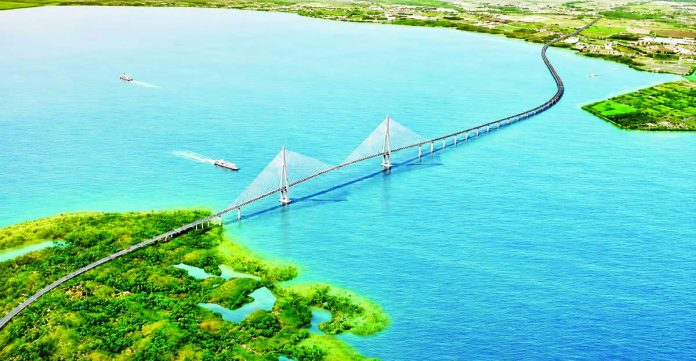
ILOILO City — Further delays in the Panay-Guimaras-Negros (PGN) Island Bridges Project could drive its P331.59-billion cost even higher, prompting Western Visayas officials to push for immediate implementation following the signing of its detailed engineering design (DED).
The warning comes as the long-awaited 32.47-kilometer inter-island bridge network enters another critical stage, with its DED signed on August 28 and the project now headed to the Economy and Development Council (EDC), chaired by President Ferdinand Marcos Jr., for final assessment and approval.

Arecio Casing Jr., regional director of the Department of Economy, Planning, and Development (DEVDep) in Western Visayas, warned that prolonged delays could make it increasingly difficult for the government to absorb further inflation-driven increases.
“This is a big activity. The price of the bridge has almost doubled,” Casing said.
The PGN bridge system is designed to establish a permanent road connection among Panay, Guimaras and Negros and replace the current three- to four-hour ferry and roll-on/roll-off travel between the islands.
Section A will span 13 kilometers between Panay and Guimaras, including a 4.97-kilometer sea-crossing bridge connecting Leganes, Iloilo and Buenavista, Guimaras.
Section B will span 19.47 kilometers from San Lorenzo, Guimaras to Pulupandan, Negros Occidental, with KEXIM finalizing its financing commitment for the second leg.
The Department of Public Works and Highways (DPWH) updated the project’s cost to P331.59 billion in 2026, reflecting major design revisions, deeper foundation requirements, additional support piles and market inflation.
The figure represents a massive escalation from previous estimates.
A 1999 feasibility study by the Japan International Cooperation Agency placed the project’s cost at P53 billion.
The DPWH lowered the estimate to P28.50 billion in 2010 following a downscoped technical assessment before recalculating it to P54 billion in 2011.
The estimate subsequently climbed to P187.53 billion before the latest engineering and design requirements pushed the projected cost to P331.59 billion.
With the price already surging dramatically, Casing said there is little room for further delays once the engineering design is ready for implementation.
“We are really hoping that whatever gets finished in the DED should really get implemented as soon as possible,” Casing said.
“There are buffers on inflation. However, if it takes a very long time, we will have a hard time adjusting. The strategy now is, the moment that the DED is released, we need to implement it as soon as we can,” he added.
RACE TO 2027 CONSTRUCTION
Once the EDC, formerly the National Economic and Development Authority Board, gives the project the go-ahead, the Department of Finance will formalize its funding arrangements.
Official Development Assistance for Section A has been committed by South Korea’s Export-Import Bank (KEXIM).
Following a schedule reset to address right-of-way and land-use requirements, procurement is targeted to continue until the middle of 2027.
“We target the procurement this year until the middle of next year (2027), and hope we will be awarding the contract package by middle of next year,” said Casing.
The contract package is targeted for award by mid-2027, with construction of Section A expected to begin in the fourth quarter of 2027 and Section B in the first quarter of 2028.
Both sections are eventually expected to be constructed simultaneously, with the entire bridge network targeted for completion by mid-2033.
PANAY EXPRESSWAY MOVES
Meanwhile, another major Western Visayas infrastructure proposal — the Iloilo-Capiz-Aklan Expressway (ICAEX) — is advancing, with procurement for its feasibility study and detailed engineering design underway.
The preliminary studies and technical design are being financed through a special development fund managed by the Public-Private Partnership Center.
“The Public-Private Partnership (PPP) Center has a special fund, the budget fund availability wherein, their procured FS and ED are financed by that one. Probably they will publish a procurement for ICAEX and once the proponent wins, they will receive that fund,” said Casing.
“However, however it if once evolve into a PPP project, the winner will repay the expenses…para siyang revolving fund,” said Casing.
Under the arrangement, the winning private concessionaire will reimburse the government for the initial study and advisory expenses once the project proceeds as a PPP.
The proposed ICAEX will stretch approximately 210 kilometers through two cities and 20 municipalities across Iloilo, Capiz and Aklan.
It is envisioned to shorten travel times across Panay, ease congestion along national highways, strengthen regional supply chains and support tourism corridors.
ILOILO AIRPORT PPP
Casing also confirmed that the previous unsolicited private proposal to rehabilitate and operate the Iloilo International Airport has been withdrawn.
The Department of Transportation is instead shifting to a solicited PPP scheme, allowing qualified private proponents to compete for the modernization and operation of the airport.
“We continue to drumbeat together with the Regional Development Council and continue to be a link between the region and national offices in all of our activities,” Casing said./PN
DPWH PHOTO