




ILOILO – More than 3,000 barangays across Western Visayas have been identified as highly vulnerable to flooding and landslides as Typhoon “Tino” barrels toward the region, threatening to affect over 2.3 million residents or nearly 60 percent of its population.
Latest data from the Regional Disaster Risk Reduction and Management Council (RDRRMC) and the Mines and Geosciences Bureau (MGB) showed that 3,227 barangays in 101 municipalities and cities are exposed to severe rain-induced hazards, prompting intensified disaster preparations by local authorities.
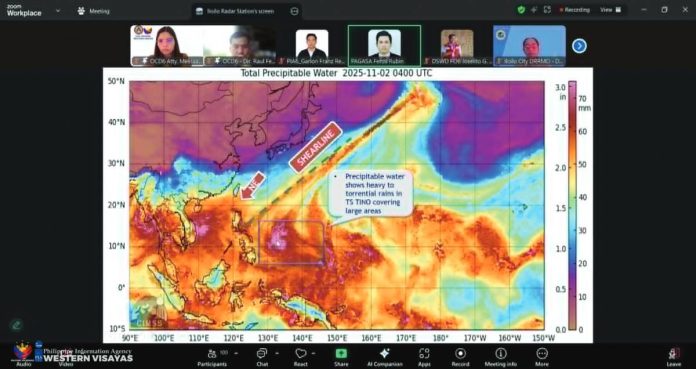
In a virtual emergency meeting on Sunday afternoon, November 2, the RDRRMC and local disaster management offices tackled potential scenarios and readiness measures as the storm — forecast to intensify further — approaches Panay Island.
The Department of Science and Technology – Philippine Atmospheric, Geophysical and Astronomical Services Administration (DOST-PAGASA) warned that “Tino” could escalate into a stronger category before making landfall by today, November 4.
Meteorologists projected torrential rainfall and strong winds that could trigger flash floods and storm surges in low-lying and coastal areas.
The MGB has mapped all vulnerable barangays to guide local government units (LGUs) in implementing pre-emptive evacuations and emergency responses.
“This proactive approach,” the agency said, “is designed to ensure the safety of residents, particularly in high-risk zones.”
According to the Predictive Analytics for Humanitarian Response (PAHR), around 466,044 families could be directly affected — representing nearly 60 percent of Western Visayas’ total population based on Philippine Statistics Authority data.
The Department of Social Welfare and Development (DSWD) has positioned 99,955 family food packs at its regional warehouse in Oton, Iloilo, and in 55 prepositioned sites across the region.
Another 10,000 food packs are expected from the Visayas Disaster Resource Center in Cebu, along with 3,100 ready-to-eat items and over 10,000 non-food essentials ready for distribution.
Director Raul Fernandez of the Office of Civil Defense (OCD) Region 6 reminded local DRRMCs of their crucial role in keeping communities alert. He urged residents in identified danger zones to heed advisories and evacuation orders as weather conditions worsen.
“Communities must remain alert and cooperate fully with disaster management protocols to safeguard lives,” Fernandez emphasized, noting that Typhoon Tino’s intensity is comparable to that of past destructive storms like “Yolanda” and “Odette”./PN