




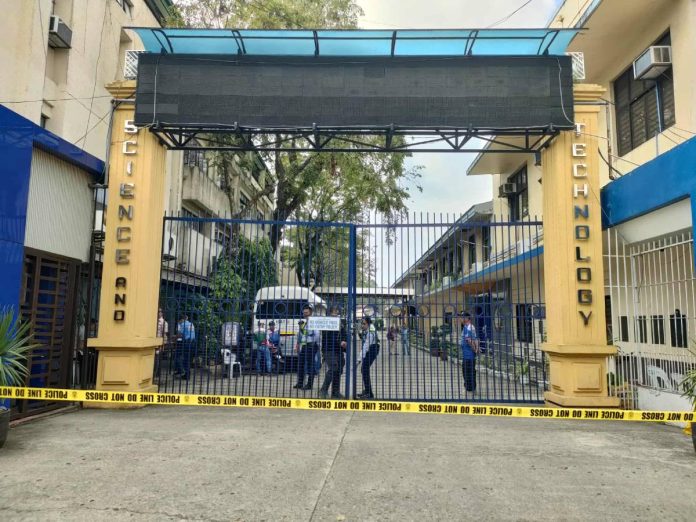
ILOILO City – A string of bomb threats targeting multiple schools in Iloilo City and Iloilo province this week triggered evacuations, campus lockdowns, and online class shifts as police and local government officials vowed to identify and prosecute the perpetrators behind what they described as dangerous and criminal acts intended to sow fear among students and educators.
The threats — sent through anonymous social media accounts — hit three campuses in two days: the University of San Agustin – Sambag Campus and West Visayas State University – Janiuay Campus on Nov. 12, followed by Iloilo Science and Technology University (ISAT-U) in La Paz on Nov. 13.
All sites were later declared safe after extensive sweeps by Explosives and Ordnance Disposal (EOD) teams and K9 units.
Yesterday morning, panic rippled across ISAT-U after a Facebook account — under the name “Shubeyaa Lily” — claimed that “I have planted 5 timed bombs in the campus – 3 at the New Site and 2 at the Old Site. Goodluck!”
Face-to-face classes were suspended and thousands of ISAT-U students sent home.
By 11:10 a.m., the Explosive Ordnance Disposal (EOD) team of the city police declared the campus safe.
“We are working closely with law enforcement to trace the individuals or groups responsible and prevent any future incidents,” said ISAT-U information officer Prof. Heinz Gumaquil.
Prior to the ISAT-U threat, the first targeted the University of San Agustin. A social media message claiming the planting of six timed bombs — “two at the kinder building and four at the main building” — spread among students early Wednesday.
The sender, using the name “Sarah Bautista,” alleged retaliation for “unjust treatment” by teachers.
“I have planted 6 timed bombs on the campus, 2 at the kinder building and 4 at the main building… This is due to the unjust treatment of some teachers of students. Good luck,” the message read.
After a tense two-hour sweep, Police Captain Mavin Laraño, chief of the Iloilo City Police Station 3, confirmed: “No explosives were found within the university premises.”
Also that same Wednesday, West Visayas State University – Janiuay Campus received a bomb threat.
The Police Regional Office 6 (PRO-6) condemned the threats, stressing that all campuses affected had been cleared after “thorough verification.”
“The safety of our students and school personnel is our top priority. We strongly condemn any act meant to sow fear and disrupt the peace in our communities,” said Police Brigadier General Josefino Ligan, PRO-6 regional director.
Ligan also reminded the public that issuing false bomb threats is a crime under Presidential Decree 1727, punishable by up to five years in prison and fines of up to P40,000.
Iloilo City’s Mayor Raisa Treñas, alarmed by the series of hoaxes, directed the Iloilo City Police Office (ICPO) to fast-track the identification of the senders.
“This is unacceptable as it disrupts the classes of our children and causes fear among teachers, students, parents, and the public,” Treñas said.
She added: “We want to make it clear that these threats should not be treated as jokes. This is a serious concern for our students, teachers, and the public.”
Treñas met with ICPO officials and emphasized the need for strong digital tracing efforts. She stressed that past bomb-threat perpetrators in the city had already faced criminal charges — a warning she said applies once again.
“Protecting our schools and ensuring the normal learning of our children is our top priority,” she added.
Authorities continue to trace the anonymous accounts, though investigators reported initial difficulty due to locked privacy settings. Cybercrime personnel are now pursuing digital leads.
As campuses return to normal, police urged the public to remain vigilant and immediately report suspicious messages or activities to 911 or the nearest police station.
PRO-6 also appealed to the public to avoid spreading unverified information that could worsen panic.
Despite the hoaxes, officials stressed that Iloilo’s schools remain safe, with security measures now heightened across academic institutions./PN