




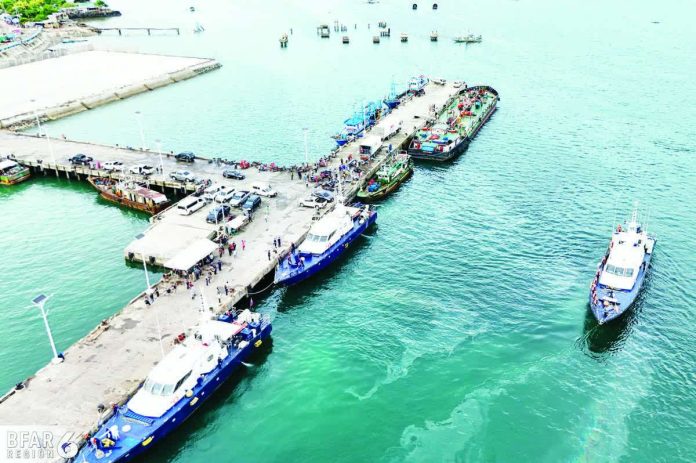
ILOILO — With illegal fishing still threatening the country’s most productive marine corridor, fisheries officials from Western and Central Visayas have tightened inter-regional coordination as the two areas observe the annual Visayan Sea closed season.
In a joint policy dialogue held on November 14 in Estancia, Iloilo, Bureau of Fisheries and Aquatic Resources (BFAR) Region 6 director Remia Aparri and Region 7 director Mario Ruinata convened enforcement agencies, local leaders, and fisherfolk groups to strengthen implementation of Fisheries Administrative Order (FAO) 167-3, which imposes a three-month fishing ban in the Visayan Sea.

Aparri stressed that credible enforcement hinges on broad cooperation among coastal communities and government units.
“Each enforcement patrol, community dialogue, and compliance report contributes to a larger vision that the Visayan Sea continues to provide food, income, and identity to our coastal communities,” she said.
Ruinata, for his part, highlighted the need to intensify ground-level compliance.
“This time, we have more mitigation and more campaigning to do,” he said, urging fishers to take a proactive role in conservation.
Fisherfolk seek clarity; enforcement agencies assure support
During the open forum, fisherfolk led by Estancia FARMC chairperson Boy Pagao raised questions on the scope and rationale of the seasonal ban.
Representatives of the Philippine Coast Guard, Philippine National Police Maritime Group, Philippine Navy, and Philippine Ports Authority assured their full support for the three-month closure running from November 15, 2024, to February 15, 2026.
Legal and scientific basis reaffirmed
Atty. Jan Rey Magallosa detailed the legal foundations of FAO 167-3, while NSAP (National Stock Assessment Program) Region 6 project leader Sheryll Mesa presented scientific data confirming that the closure is crucial for the spawning of sardines, herrings, and mackerels — species central to the region’s food security and marine biodiversity.
Community engagement emphasized
To deepen public awareness, BFAR-6 introduced a community song titled “Magbinuligay para mas Masulhay” to inspire cooperation among coastal villages during the fishing ban.
Patrols intensified
BFAR-6 also launched intensified seaborne patrols, describing the closure — locally known as “pahuwà sang baybay” — as essential to safeguarding the ecosystem.
In a public statement, the bureau reiterated: “By regulating fishing activities, BFAR seeks to maintain fish abundance, preserve marine biodiversity, and strengthen long-term food security.”
Officials emphasized that safeguarding the Visayan Sea now rests on sustained vigilance, strong coordination, and community-driven compliance./PN