
MANILA – President Ferdinand “Bongbong” Marcos Jr. reaffirmed his administration’s commitment to education reform after receiving two major policy blueprints aimed at addressing long-standing problems in the country’s school system.
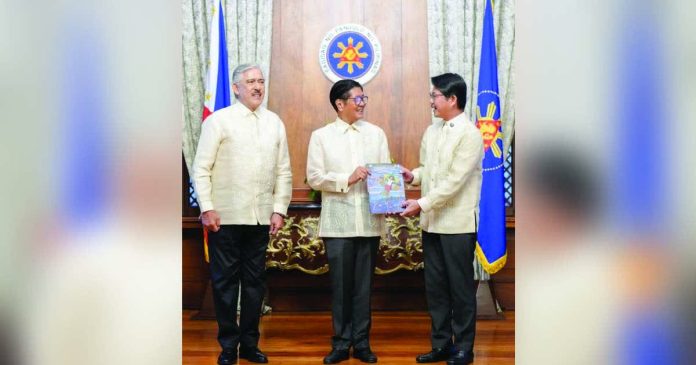
The President accepted the final report of the Second Congressional Commission on Education (EDCOM 2) and the National Education and Workforce Development Plan (NatPlan) 2026–2035 during a ceremony at Malacañang on Thursday, January 29.
The EDCOM 2 report summarizes the results of a three-year nationwide assessment of Philippine education, while NatPlan outlines a 10-year strategy designed to align basic, higher, and technical education with the country’s economic priorities.
The roadmap integrates the programs of the Department of Education, Commission on Higher Education, and the Technical Education and Skills Development Authority.
In his remarks, Marcos said the documents point to both the system’s weaknesses and the steps needed to correct them.
“These documents reveal where we have fallen short and what we must do to improve our educational system,” he said.
The President cited learning gaps worsened by the pandemic and climate-related disruptions as among the major challenges confronting Filipino students.
“Throughout these past years, we have focused much of our efforts on addressing learning gaps and the damage caused by the pandemic to our children’s education and the continuing cost that we are paying because of climate change,” he said.
Marcos also highlighted reforms in the basic education curriculum, which he described as “learner-centered, skill-focused, and decongested.”
He underscored the government’s proposed P1.3-trillion allocation for education in the 2026 national budget, saying it represents a significant milestone.
“This works out to the equivalent of 4.36 percent of the country’s gross domestic product, and that exceeds the global benchmark for education spending for the first time in Philippine history,” he said.
According to the President, the increased funding will support teacher hiring, learning recovery programs in reading, mathematics, and science, school-based feeding initiatives, and the construction of additional classrooms.
“Through this budget, we can hire more teachers to reduce their overall workload; implement learning recovery in reading, math and science; expand school-based feeding programs; and construct more classrooms, further improving our educational system,” he said.
Marcos called the reforms a critical step in the administration’s broader development agenda./PN