
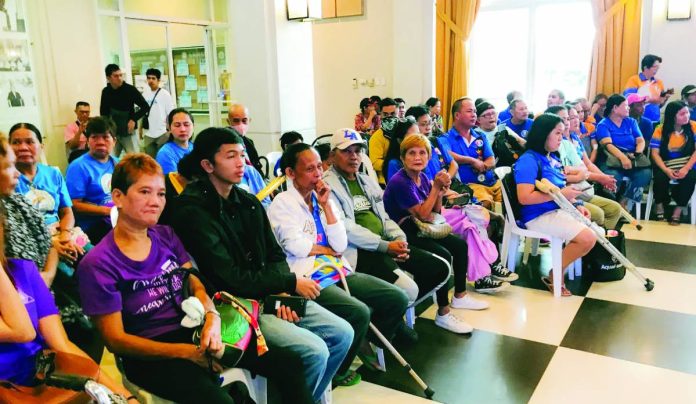
BACOLOD City — The Bacolod City Government has expanded its social protection program for persons with disabilities (PWDs) following the unanimous approval on third and final reading of the proposed “PWD Social Pension Reform Ordinance” by the Sangguniang Panlungsod (SP) on Monday, February 23.
The measure, authored by Councilor Atty. Caesar Distrito, chairperson of the SP Committee on PWD Affairs, strengthens and broadens the city’s social pension program to make assistance more inclusive and responsive to the needs of vulnerable sectors.
The ordinance amends Sections 3 and 4 of City Ordinance No. 1010, Series of 2022, originally authored by Councilor Celia Flor, by updating the definition of persons with disabilities and expanding eligibility qualifications for social pension support.
Under the revised measure, the definition of disability now expressly includes orthopedic, visual, hearing, chronic illness, deaf-mute, and psychosocial disabilities. It also specifically covers individuals with autism, Down syndrome, epilepsy, and other developmental conditions.
To qualify for the social pension, a PWD must be a registered voter of Bacolod City. Those who are not of voting age or are physically unable to register must have been residents of the city for at least one year.
Applicants must also fall under specific circumstances, such as being bedridden; having severe or terminal illnesses like cancer; being unemployed with two or more dependents; living alone or residing with another PWD or senior citizen; being a child with developmental disabilities such as autism or Down syndrome; having epilepsy or other chronic psychosocial disabilities; being blind in both eyes; or having severe physical impairments, including amputation of both legs or both hands, or similar orthopedic conditions.
The recipient must also meet the income threshold requirement, which sets the annual gross income cap at P180,000. If the PWD is a dependent or has no independent income, the combined annual income of the parents, guardian, or primary caregiver must likewise not exceed P180,000.
The ordinance establishes a clear income cap to ensure that limited city resources are directed toward the most economically vulnerable PWDs.
Distrito said the reform reflects the city’s continuing commitment to inclusivity and social justice.
“This reform strengthens our commitment to genuine inclusivity. By refining the definition and expanding the qualifications, we ensure that more vulnerable persons with disabilities—especially those facing severe medical, economic, and social challenges—can access the assistance provided by the city government,” he said./PN