




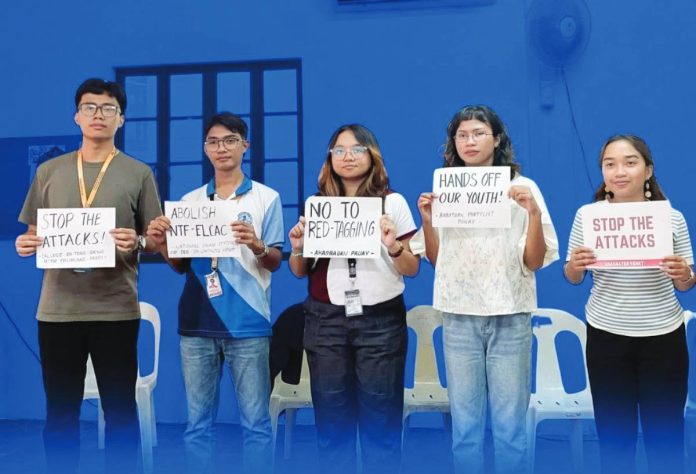
ILOILO City — Youth organizations in Western Visayas condemned the National Task Force to End Local Communist Armed Conflict (NTF-ELCAC) after several progressive student groups were red-tagged during a forum at Central Philippine University (CPU), triggering outrage and prompting the university to review the incident.
The controversy stemmed from a Feb. 28 “peace awareness” forum at CPU where a speaker described several national youth organizations of serving as front groups of the Communist Party of the Philippines (CPP), the New People’s Army (NPA), and the National Democratic Front of the Philippines (NDFP).
Organizations identified during the presentation included the College Editors Guild of the Philippines (CEGP), the National Union of Students of the Philippines (NUSP), the League of Filipino Students (LFS), Anakbayan, the Student Christian Movement of the Philippines, and Kabataan party-list.
In May 2024, the Supreme Court ruled that red-tagging poses a serious threat to a person’s “right to life, liberty, or security,” underscoring the legal and human-rights implications of labelling individuals or groups as communist fronts without evidence.
Student leaders and youth activists quickly condemned the CPU incident, warning that such accusations place students and activists at risk.
Alek Padrones, representative of the Oikos Ecological Movement—Lopez Jaena, said the materials used in the forum resembled those commonly circulated by the NTF-ELCAC.
“The materials employed in the orientation sessions have remained consistent over the years, often incorporating unfounded allegations against various organizations,” he said.
Padrones warned that the repeated use of such materials in academic activities reflects what he described as a pattern of systematic red-tagging within educational settings.
Arlie Bosque of Kabataan party-list in Panay went further, calling for the abolition of the NTF-ELCAC.
“We must advocate for the dismantling of this task force. How can we effectively lobby for safe policies when the primary function of this agency is to endanger the lives of students?” Bosque said.
Matt Gonzaga, coordinator of NUSP Panay, also defended the legitimacy of the student organizations accused during the forum.
“We are recognized as legitimate organizations and sources; we have no affiliations with any rebel groups,” Gonzaga said, expressing concern over what he described as the normalization of red-tagging within educational institutions.
The incident revived concerns over similar cases in universities. In February 2024, a comparable controversy erupted at West Visayas State University where legal organizations were also labelled as fronts of underground armed groups.
During that episode, Flosemer Chris Gonzales, spokesperson of the regional task force, denied that red-tagging was part of state policy despite complaints from affected groups.
Meanwhile, CPU issued a statement acknowledging the concerns raised by youth organizations and reaffirming its commitment to protect students’ rights and welfare.
Anne Gilongos, coordinator of the university’s National Service Training Program (NSTP), clarified that the forum was intended as part of a peace and awareness initiative.
“As NSTP Coordinator, I take seriously the concerns raised regarding the recent NSTP Orientation activity. The lecture formed part of a Peace and Awareness initiative and included a presentation referencing materials publicly attributed to the national government and the National Task Force to End Local Communist Armed Conflict (NTF-ELCAC). The speaker clarified that she was presenting the government’s stated position and did not intend to engage in red-tagging,” she said.
“NSTP seeks to promote civic consciousness, critical thinking, and responsible citizenship. While discussions on sensitive national issues may generate differing views, the University remains committed to ensuring that all activities are conducted in a respectful and constructive manner, safeguarding the welfare and rights of our students,” she added.
The university also stressed that the views expressed by invited speakers do not necessarily reflect the institution’s official position.
CPU said it is reviewing the circumstances surrounding the forum to determine whether its standards for balanced and respectful dialogue were observed.
Despite the university’s clarification, youth groups said the incident highlights the continuing tension between government security narratives and student activism on campuses, warning that red-tagging remains a pressing concern for the country’s youth sector./PN