


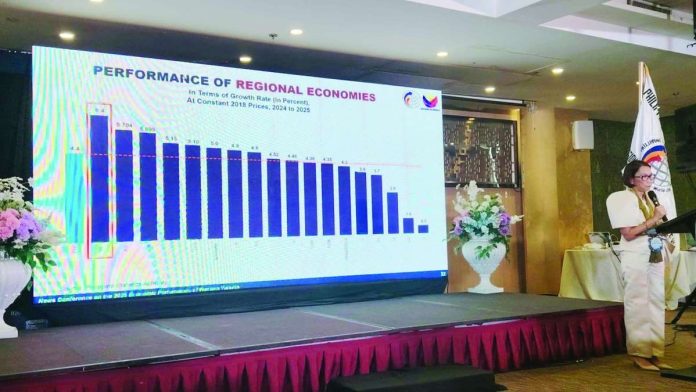
ILOILO City — Western Visayas emerged as the Philippines’ fastest-growing regional economy in 2025, posting a robust 6.4-percent expansion to lead all 18 regions, driven by a strong rebound in agriculture, sustained industry gains, and resilient consumer demand, according to economic managers.
This marks a sharp acceleration from the region’s 4.4-percent growth in 2024, signaling renewed economic momentum despite global uncertainties.
“The projected growth of 6.4% not only exceeds earlier forecasts of 5% to 5.5%, but it also reflects a thriving economic environment characterized by heightened consumer spending and increased investment across various sectors,” said Engr. Arecio Casing Jr., regional director of the Department of Economy, Planning and Development (DEPDev), during a press conference.
Data showed the region’s gross regional domestic expenditure climbed to P683.44 billion in 2025 from P642.47 billion in 2024 at constant 2018 prices, highlighting expanded economic activity across key sectors.
Nelida Amolar, regional director of the Philippine Statistics Authority (PSA) in Western Visayas, said growth was anchored on the combined strength of agriculture, industry, and services.
“The economic fabric of our region is woven from three critical industries: Agriculture, Forestry, and Fishing (AFF); industry; and services, all of which demonstrated positive growth trajectories in 2025,” Amolar said.
The agriculture, forestry, and fishing sector led the rebound, surging 9.5% in 2025 from a contraction of -7.4% the previous year.
“We saw impressive growth in agriculture, particularly in the production of essential crops like palay (rice), corn, and sugarcane,” Amolar added.
The industry sector sustained its expansion at 4.3%, supported by increased manufacturing output and ongoing infrastructure projects.
“Industry sustained its growth momentum over the past three years, with a consistent growth rate of 4.3% in 2025 compared to 4.1% in 2024,” Amolar said.
Meanwhile, the services sector grew by 6.3%, slightly slower than the 7.5% recorded in 2024, although key subsectors continued to post strong gains.
Mining and quarrying expanded by 14.8%, driven by demand for construction materials, while human health and social work activities grew by 14.6% amid increased investments in healthcare.
The construction sector, however, dipped slightly by 0.5% due to project delays and financial adjustments.
Despite this, labor indicators remained strong, with unemployment at 4.1% and poverty incidence among families holding at a single-digit 9.8%.
“Our region posted a low unemployment rate of 4.1%, reflecting strong labor absorption, while poverty incidence among families remains at a single-digit 9.8%, positioning Western Visayas among the least poor regions in the country,” Casing said.
He added that economic growth is translating into broader social gains.
“Our growth rate correlates positively with enhanced labor opportunities and declining poverty incidences. While other regions contend with poverty levels surpassing 10%, Western Visayas remains below this threshold, demonstrating our capacity for sustained economic progress,” he said.
Amolar noted that employment rose by 28,500 in 2025, further boosting household income and spending.
“In terms of numbers, employment in our region increased by 28,500 in 2025, supporting household income and helping families cope with the rising cost of living,” she said.
Western Visayas ranked as the eighth-largest economy among the country’s regions, contributing 2.9% to the national gross domestic product.
Officials said sustained investments and coordinated policies will be critical to maintaining the region’s growth momentum and strengthening its role as a key economic driver in the Philippines./PN