



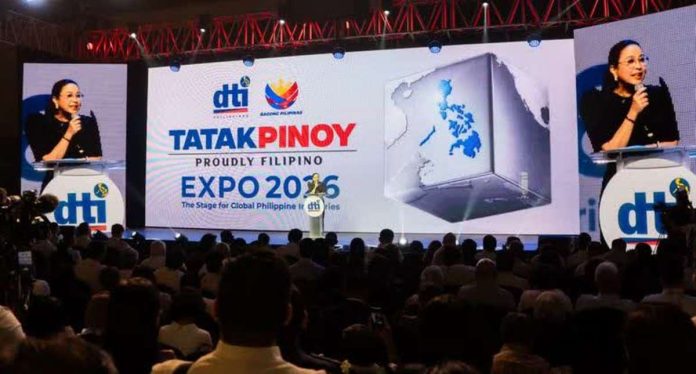
AS THE government pushes to make Philippine-made products more globally competitive, the Department of Trade and Industry (DTI) is developing a certification seal meant to identify Filipino goods and services that meet the country’s industrial policy standards.
At the three-day Tatak Pinoy Expo 2026 on May 25 to May 27, the DTI formally unveiled the Tatak Pinoy Seal, which will serve as the government’s official marker for high-quality and innovative products and services produced in the Philippines.
This seal is expected to become a key mechanism under Republic Act No. 11981, or the Tatak Pinoy Act, which aims to strengthen local industries, boost manufacturing and help Filipino firms move up the global value chain.
What the DTI envisions is for the seal to become both a “brand of excellence” and “a practical tool for public agencies and private buyers to recognize firms committed to national development goals.”
“The seal is our symbol of high-quality, innovative and globally competitive products,” Trade Secretary Cristina Roque said.
The expo gathered 79 exhibitors across nine priority industries.
“By giving products bearing this seal a direct aggressive preference in government procurement, we are ensuring that public funds are used strategically to buy Filipino, support Filipino and grow Filipino,” Roque added.
Guidelines for the Tatak Pinoy Seal are still being finalized and are targeted for approval within the first half of 2026.
According to the DTI, consultations have already been conducted with more than 300 stakeholders representing 96 companies and industry associations across the nine priority sectors.
These sectors are: information technology-business process management; food and agro-processing; cement, steel and construction materials; semiconductors; electronics and electrical devices; automotive, e-vehicles and automotive components; pharmaceuticals, diagnostics and health products; defense manufacturing; and chemical and industrial inputs.
Economic impact
Once fully implemented, the Tatak Pinoy Strategy is expected to create 11.13 million jobs, contribute P7.04 trillion to the economy and generate up to P900 billion in new government revenue.
Philippine-made products and services covered by the strategy will receive preference in government procurement for 10 years. This includes inputs and raw materials, although waivers may still be granted in cases of insufficient domestic supply or quality.
Under the policy, local suppliers may also secure government contracts if their bids fall within 25 percent of the lowest foreign offer, allowing the government’s purchasing power to directly support Filipino enterprises. (Logan Kal-El M. Zapanta © Philippine Daily Inquirer)