



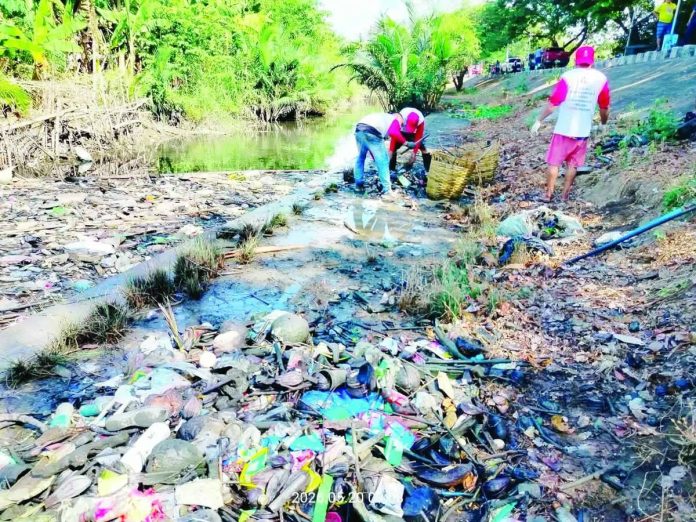
ILOILO City – The city government’s anti-flood campaign has uncovered what officials describe as an environmental crisis after workers hauled 74 tons of garbage from rivers and creeks in just two weeks, exposing the extent of waste accumulation blamed for worsening flooding and pollution in the city.
The volume of waste recovered under the city government’s “Oplan Kontra Baha” alarmed officials, who warned that the figure could soon exceed 100 tons as cleanup operations move deeper into upstream sections of the Jaro River and adjoining waterways.
City General Services Office (GSO) head Engr. Neil Ravena said the amount of garbage collected since the campaign began on May 18 reflects years of neglect and improper waste disposal in the city’s river systems.
“The volume was slightly lower during the second week, probably because there was less garbage in some areas, but as we moved farther upstream toward Baldoza and the boundary of La Paz and Jaro, we continued to find significant amounts of waste,” Ravena said.
Cleanup operations have covered barangays Ingore, Ticud, and portions of Baldoza in La Paz district, with teams now moving toward Caingin and other upstream areas in an effort to remove waste that clogs waterways and contributes to flooding.
“The volume of waste we have recovered is really alarming. If we continue gathering and disposing of everything we find, we could easily reach 100 tons of waste. This indicates that garbage has been accumulating in the Jaro River for a long time,” he said.
Ravena said the environmental consequences extend beyond flood-prone communities, noting that much of the waste eventually reaches coastal waters.
“With tidal movements, this waste eventually reaches the sea. It can contribute to the formation of microplastics that are consumed by fish and, eventually, by people,” he said.
Data from the cleanup drive showed plastic waste dominated initial collections, accounting for about 80 percent of the garbage gathered during the first week. More recent collections revealed a nearly equal mix of plastic and organic waste.
“During the first week, around 80 percent of the waste was plastic. In the most recent 20 tons we collected, the composition was closer to 50 percent plastic and 50 percent organic waste,” Ravena said.
To identify pollution sources, the city government plans to install waste traps in seven barangays along upstream and downstream sections of the river system.
“The city plans to install waste traps at strategic locations along waterways, beginning at the boundary between La Paz and Jaro, to determine which communities are contributing the most garbage,” Ravena said.
“Once we finish installing the waste traps in La Paz, we will move to Jaro. This will help us determine exactly where the garbage is coming from,” he added.
Despite the gains, cleanup crews continue to face operational challenges due to frequent rains and rising water levels.
“One of our biggest challenges is the rain. It becomes difficult for workers to move through the area, especially when water levels rise. Even with protective equipment, the work remains physically demanding,” Ravena said.
To protect workers from diseases such as leptospirosis, the city government provides prophylactic medication before deployment.
“We provide prophylaxis tablets to all workers who are exposed to floodwaters. Our nurses personally explain how to use the medication and administer it properly,” he said.
The city has also expanded the use of floating platforms during cleanup operations.
“We added two more rafts, bringing the total to four. This allows workers to collect waste more safely and efficiently without having to stay in the water for extended periods,” Ravena said.
City officials said river cleanup operations will continue and eventually expand to other waterways, including the Patayan River, as part of a long-term strategy to reduce flooding, improve water quality, and prevent waste from reaching marine ecosystems./PN