

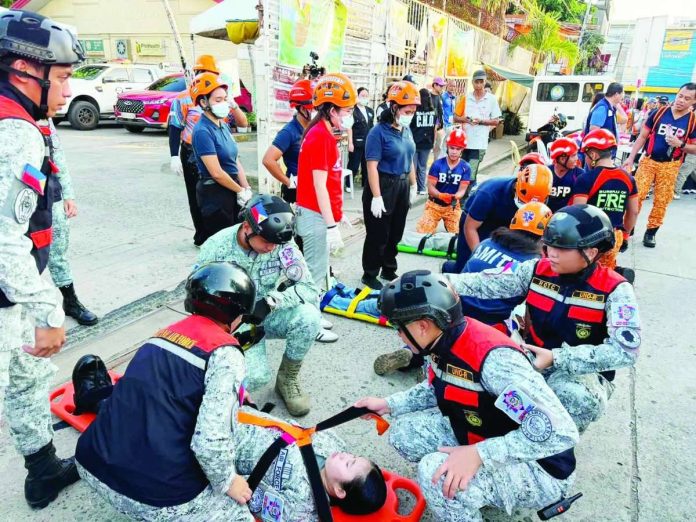
BACOLOD City – More than 100 emergency responders from Bacolod City and neighboring local government units participated in a citywide Rescue March on July 18 to strengthen disaster preparedness and inter-agency coordination as part of the observance of National Disaster Resilience Month.
Organized by the City Disaster Risk Reduction and Management Office (CDRRMO), the exercise simulated the aftermath of a magnitude 7.2 earthquake that left roads and bridges impassable, requiring rescue teams to conduct emergency operations entirely on foot.
The activity brought together members of civilian volunteer rescue organizations, barangay rescue teams, and emergency response units from the cities of Bago and Talisay, and the municipality of Murcia. Representatives from the Office of Civil Defense also joined the exercise.
Secretary to the Mayor Atty. Marty Go said the Rescue March was designed to prepare responders for situations where damaged infrastructure prevents the use of vehicles.
“The objective is to train rescuers to continue responding even when transportation is unavailable due to a major disaster. They must be physically prepared to reach victims on foot and carry out rescue operations under difficult conditions,” Go said.
Participants assembled at the Bacolod Public Plaza before proceeding to the Bureau of Fire Protection (BFP) Main Station on San Juan Road for a simulated firefighting operation.
The teams then moved to the Development Bank of the Philippines (DBP) South Capitol area to conduct a mass casualty evacuation. Responders transported simulated earthquake victims using spine boards, firefighter’s carry techniques, and assisted walking methods before bringing them to the City Health Office (CHO).
Medical personnel from the CHO and the Philippine Red Cross demonstrated emergency medical procedures, including cardiopulmonary resuscitation (CPR) and bleeding control.
The exercise continued at the Megaworld area, where responders carried out vehicle extrication and rescued victims trapped inside a simulated collapsed structure.
The final phase involved a hazardous materials response after a simulated gasoline tanker leak at the designated ground zero site. Specialized Chemical, Biological, Radiological, Nuclear and Explosives (CBRNE) responders established safety perimeters, identified hazardous substances, and demonstrated containment procedures such as plugging and diking while wearing protective suits.
The Rescue March concluded with a final personnel accountability check and equipment inspection to ensure all participants safely completed the exercise.
Go said the annual activity aims to enhance the operational readiness of emergency responders and strengthen coordination among agencies in preparation for large-scale disasters and other emergency situations./PN