


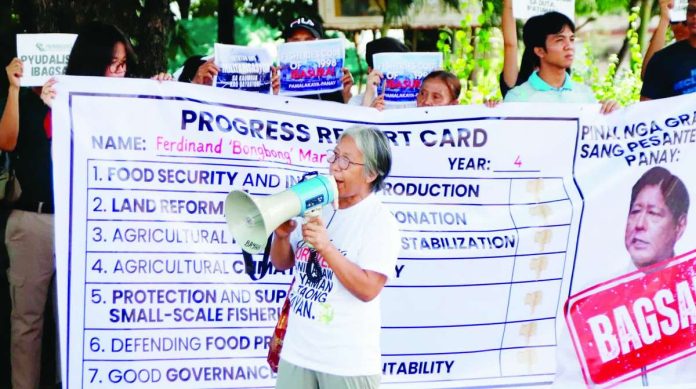
ILOILO City — Peasant organizations in Panay and Guimaras islands gave President Ferdinand Marcos Jr.’s administration a failing grade on its agriculture and fisheries performance, accusing the government of failing to deliver on key promises on food security, genuine land reform, support for small farmers and fisherfolk, and climate resilience during the first four years of his term.
The scathing assessment was delivered during the State of Panay Peasant Address (SOPPA) Forum on July 17, where more than 70 representatives from peasant and fisherfolk groups led by Paghugpong sang mga Mangunguma sa Panay kag Guimaras (PAMANGGAS) unanimously gave failing marks to the administration in seven major areas:
* food security and increased production
* land reform and debt condonation
* agricultural market and price stabilization
* climate resiliency
* protection of small-scale fisheries
* democratic rights of food producers, and
* good governance and accountability
“The collective view expressed by attendees was that the current administration’s policies have been ineffective in addressing their needs and concerns,” the groups said in a statement.
The assembly took particular aim at the government’s Support to Parcelization of Lands for Individual Titling (SPLIT) Program, arguing that while some 15,000 collective Certificates of Land Ownership Award (CLOAs) covering about 181,000 hectares have reportedly been parcelized, the initiative has not translated into genuine land redistribution.
According to the groups, around 380,000 farmers in Western Visayas still do not own the land they till, while only about 7,500 farmers have benefited from the debt condonation provisions under the New Agrarian Emancipation Act.
They also claimed that no significant increase in land distribution has been achieved under the Comprehensive Agrarian Reform Program (CARP) since 2014.
The organizations also blamed continued land conversion for worsening the plight of farmers, claiming that about 4,000 hectares of agricultural land in Iloilo province have been converted for commercial developments, displacing farming communities in Santa Barbara, Pavia, Oton, and San Miguel. They identified major developers, including Ayala, SM Holdings, and Megaworld, as among those linked to projects affecting farmlands.
The forum likewise criticized the administration’s much-publicized P20-per-kilogram rice program, saying it has failed to materialize because of funding requirements and bureaucratic obstacles.
Participants noted that only 472,388 farmers in Western Visayas have been registered under the Registry System for Basic Sectors in Agriculture (RSBSA), a figure they described as inadequate compared to the estimated 11 million farmers nationwide. They also argued that the P20 rice initiative merely masks rising rice prices while the country continues to rely heavily on imports under the Rice Tariffication Law, with the Philippines importing more than 3 million metric tons of rice in 2025.
The peasant groups further questioned government spending priorities, claiming that while an estimated 10 percent of the national budget is lost to corruption, agriculture receives only about 4 percent of the national budget.
They also criticized what they described as excessive spending on farm-to-market roads while many farming communities continue to suffer from inadequate irrigation and limited agricultural mechanization.
As an example, they cited a P250-million, 28-kilometer farm-to-market road project in Passi City, equivalent to nearly P8.9 million per kilometer, which they said raises concerns over government spending.
The forum also expressed concern over what participants described as inadequate government action to address climate-related agricultural losses. They noted that the 2023-2024 El Niño caused an estimated P9.89 billion in damage to the agriculture and fisheries sectors and cited the severe impact on rice production in Panay.
Participants likewise raised alleged human rights violations against farmers, indigenous peoples, environmental defenders, and food producers, citing cases involving the Tumandok 9 and other local leaders./PN