


THE MASS arrests of some 300 protesters across Metro Manila during the holding of the 49th Association of Southeast Asian Nations (ASEAN) Summit sparked online debate on the constitutional right to protest and freedom of assembly.
The November 15, 2026 crackdown was described as the “largest single-day mass arrest under the Marcos Jr. administration.”
Police intercepted and arrested over 270 individuals (members of Lakbayan ng Timog Katagalugan and student groups) in Muntinlupa City who were heading toward Manila to join the protests.
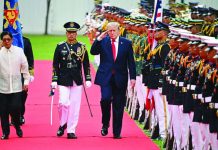
Additional arrests occurred in Liwasang Bonifacio in Manila as groups marched toward summit sites to oppose the United States-led Pax Silica semiconductor initiative and the visit of US President Donald Trump.
Pax Silica is a US-led economic and industrial initiative that aims to make the Philippines an indispensable node in digital infrastructure by securing global supply chains for advanced semiconductor packaging and critical minerals.
The flagship project is a planned 1,620-hectare AI-native industrial acceleration hub located in New Clark City, Tarlac, situated within the broader Luzon Economic Corridor.
Critics warn displacements of agrarian and indigenous communities in Tarlac and the Cordillera region as well as massive environmental and resource requirements, including high demands for electricity and ultra-pure water.
Thousands of students, teachers, and university personnel across the Philippines staged nationwide class walkouts and protests on November 13, 2026.
Malacañang urged activist groups to defer demonstrations during the event to showcase “Filipino hospitality and good values to foreign visitors”.
Police officials emphasized that assemblies must follow legal processes, stay in designated areas, and not endanger public safety, international guests, or state property. They stated that the arrests were made due to a lack of rally permits, obstruction, disruption of public order, and refusal to peacefully disperse.
The National Union of Journalists of the Philippines (NUJP) documented at least 22 media workers and student journalists who experienced arrest, attempted arrest, or police harassment during the demonstrations.
The National Union of Peoples’ Lawyers (NUPL) called for the immediate release of the detainees as they denounced the illegal arrests, deliberate obstruction of access to legal assistance, and brazen human rights violations perpetrated by state forces.
“When students, Indigenous Peoples, farmers, workers, journalists, and ordinary citizens are arrested for exercising their constitutionally protected and fundamental rights to free expression, peaceful assembly, and dissent, the legal profession cannot stand idly by while the very rights it is sworn to defend are brutally trampled upon,” NUPL said in a statement.
NUPL added: “We will pursue accountability for every unlawful arrest, every act of police brutality, and every attempt to deny the people of their right to protest. When the State weaponizes the law against the people, we too will wield it in their defense.”
Amnesty International Philippines condemned the arrests as a suppression of the constitutional right to peaceful assembly.
“Protest marches that attempt to go beyond designated spaces or barricades, are still protected by the right to peaceful assembly, and must not be forcibly or violently dispersed. The PNP must take steps to practice restraint and strict adherence to international standards on the use of force. Any use of force must be a measure of last resort, and should be in line with the principles of necessity and proportionality,” Amnesty said,
The University of the Philippines (UP) Office of the Vice Chancellor for Student Affairs strongly condemns all forms of repression and intimidation against students, individuals, and organizations exercising their right to peaceably assemble and protest, especially on urgent issues like Pax Silica. Ten UP students were included in those arrested.
“As a university that upholds honor, excellence, and service to the nation, we recognize that education extends beyond the classroom. Our students must be free to confront social realities, document and question injustice, and contribute to a more just and democratic society,” UP said.
The ASEAN Summit is the highest policy-making body bringing together the heads of state or government of its member countries twice a year to discuss regional economic, political, security, and socio-cultural development.
ASEAN comprises 11 member nations: Brunei, Cambodia, Indonesia, Laos, Malaysia, Myanmar, the Philippines, Singapore, Thailand, Timor-Leste, and Vietnam.
The summit also hosts diplomatic dialogues with global partners — including Australia, Canada, China, India, Japan, New Zealand, Russia, South Korea, and the United States.
***
“Peyups” is the moniker of the University of the Philippines.
***
Atty. Dennis R. Gorecho heads the Seafarers’ Division of the Sapalo Velez Bundang Bulilan Law Offices. For comments, e-mail info@sapalovelez.com, or call 0908-8665786./PN