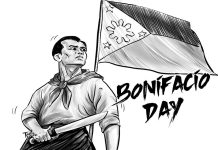



EVERY year on November 30, the nation pauses to honor Andres Bonifacio, founder of the Katipunan and leader of the Philippine Revolution. We lay wreaths, deliver speeches, and recount his heroism. Yet perhaps the more meaningful exercise is to ask a simple question:
If Bonifacio were alive today, what would he be fighting for?
History tells us that Bonifacio’s greatness did not come from privilege. Unlike many leaders of his era, he was neither wealthy nor formally highly educated. He was a warehouse clerk, a salesman, and a self-taught intellectual who immersed himself in books and ideas. More importantly, he was an ordinary Filipino who developed an extraordinary conviction that his people deserved freedom and dignity.
When reform efforts failed and Jose Rizal was exiled in 1892, Bonifacio concluded that the time for petitions had passed. He organized the Katipunan and helped launch the Revolution of 1896, changing the course of Philippine history. While others sought accommodation with the colonial authorities, Bonifacio dared imagine an independent Filipino nation.
That is the Bonifacio we should remember today.
If he were among us, his battlefield would no longer be colonialism. The Philippines is politically free. Yet many of the conditions that troubled him would still look familiar: poverty amid abundance, unequal opportunities, abuse of power, and a lingering sense among many citizens that they have little control over their own future.
Bonifacio would likely be disturbed by the persistence of corruption, the spread of disinformation, and the growing cynicism that treats public service as a spectacle rather than a calling. He would probably have little patience for endless political quarrels that generate more heat than light while leaving fundamental problems unresolved.
At the same time, he would recognize that genuine patriotism is not measured by rhetoric. It is measured by responsibility.
The revolution Bonifacio led was not merely a struggle to expel foreign rulers. At its core, it was an assertion of Filipino dignity. It was a declaration that ordinary citizens have the right and the capacity to shape their own destiny.
That principle remains as relevant today as it was in 1896.
The challenge facing the nation is no longer how to win independence, but how to make freedom meaningful. A country cannot thrive if its citizens are disengaged, if public trust continues to erode, or if national interests are repeatedly subordinated to personal and partisan concerns.
Bonifacio understood a truth that deserves remembering: nations are built not only by heroes but by citizens. The strength of a republic ultimately depends not on its leaders alone but on the willingness of its people to participate, contribute, and care.
More than a century after his death, Bonifacio’s revolution remains unfinished. The struggle today is not against a foreign empire but against the forces that limit human potential and weaken national unity.
As the nation commemorates Bonifacio Day, the question is not whether we remember Bonifacio.
The real question is whether we still possess the courage, commitment, and sense of common purpose that inspired him.
For while the Revolution of 1896 belongs to history, the work of nation-building belongs to us. And that work, now as then, demands citizens willing not merely to celebrate freedom, but to strengthen and safeguard it./PN